Paid Online Advertising Tools 2026 Top Platforms Compared for Better Results
Introduction: Navigating the Rapidly Evolving Paid Advertising Landscape
Here is a stat that might stop you in your tracks. Global digital advertising spend reached $740 billion in 2026, capturing 73% of total media investment and growing 11.4% year over year, according to the Ad Spend by Industry 2026 report. If that feels like a lot, it is. The numbers are big because the opportunity is big.
But here is the thing most people do not talk about. With that kind of money flowing into paid online advertising, the pressure to get it right has never been higher. Every dollar counts. Every platform matters. And the tools you choose to manage it all can make or break your results.
The advertising technology world is moving fast. Really fast. AI is reshaping every stage of ad campaigns. From creative generation and audience targeting to real-time bidding and attribution, the old playbook no longer applies. Platforms that did not exist five years ago are now commanding billions in ad spend. And the platforms you already know are changing faster than most teams can keep up.
This speed creates two things at once. Opportunity and overwhelm.

For media executives, marketing directors, and advertising professionals, the challenge is real. How do you pick the right pay-per-click advertising platforms when new options appear every quarter? How do you evaluate programmatic advertising platforms when each one claims to be the best? How do you decide between Google Ads Editor and Spark Ads when your team needs both speed and scale?
If you are looking for a broader view of the landscape first, our guide to digital marketing platforms in 2026 covers the full ecosystem. But here we are going deeper into the paid side specifically.
These questions do not have simple answers. But they do have a framework.
This guide is built to help you cut through the noise. We will walk through the most important paid online advertising tools available in 2026. We will look at what they do well, where they fall short, and who they work best for. By the end, you will have a clear picture of which tools deserve a spot in your stack.
The goal is simple. Help you spend less time researching and more time getting results.
Let us start with the big picture and work our way down to the tools that actually move the needle.
The State of Paid Online Advertising in 2026
So what does the big picture really look like? Let us dig into the numbers.
Global digital ad spend reached $740 billion in 2026, capturing 73% of total media investment. That is a jump from 64% just a few years ago. And growth is still strong at 11.4% year over year according to the latest digital advertising statistics for 2026.
But the headline number only tells one part of the story. Where that money actually goes is shifting fast.
Search still leads with $268 billion or 36.2% of digital ad spend. Social media is close behind at $227 billion. But the fastest growth is happening in newer areas. Retail media networks grew 26.1% year over year to reach $62 billion. Connected TV surged 19.4% to $72 billion.
These channels barely existed at this scale a few years ago.
This fragmentation creates both opportunity and complexity. You are no longer just choosing between Google and Meta. Now you have Walmart Connect, Amazon Ads, Roku, and dozens of programmatic advertising platforms all competing for your budget. Each one promises better targeting and better results. But managing them all takes serious effort.
AI is the other major force reshaping the landscape. Algorithm-driven advertising now represents 71.6% of total spend according to the 2026 Global Ad Spend Forecast Insights report. Automation is no longer a competitive advantage. It is simply the cost of entry. Every platform offers AI targeting, bidding, and creative optimization. The platforms that win are the ones that do it better than everyone else.
For media professionals, the takeaway is clear. You need tools that can handle this complexity without adding more work. Understanding the full range of types of google ads campaigns is just one piece of the puzzle. You also need to evaluate retail media networks, CTV partners, and everything in between.
The landscape is bigger and faster than ever. But that also means more opportunities to reach the right audience at the right time. The key is choosing tools that match your actual goals.
For daily updates on how AI is reshaping ad tech and the broader media landscape, check out The AI Newsletter Worth Reading.
Key Criteria for Choosing a Paid Advertising Platform
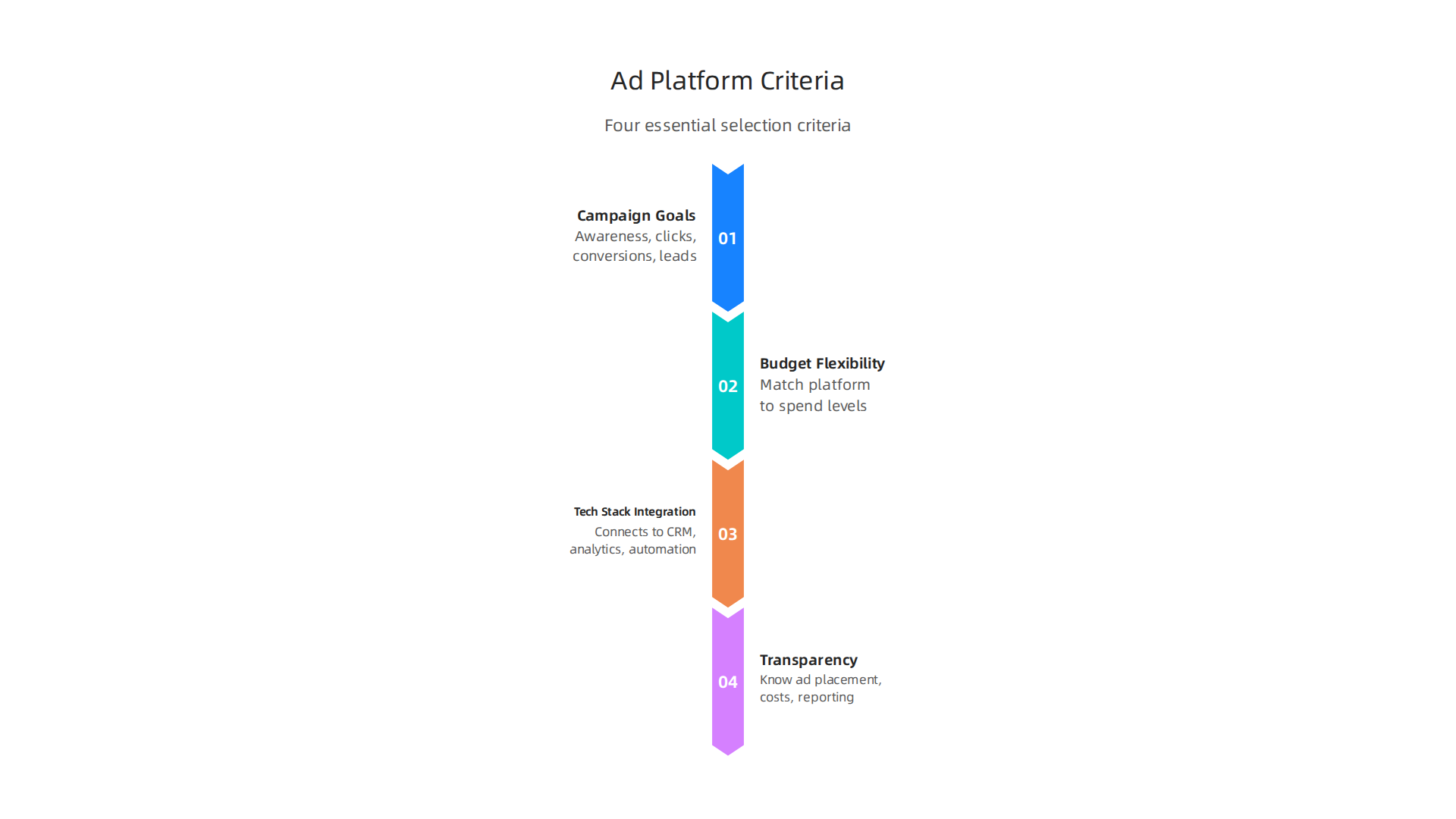
So you have a sense of the crowded ad landscape. Now the real question: how do you pick the right home for your budget? The answer starts with your campaign goals.
Every platform serves a different purpose. Google Ads captures people already searching for what you offer. That high-intent traffic often delivers the strongest return for direct response campaigns. Meta Ads and TikTok Ads excel at building demand through visual storytelling and audience discovery. LinkedIn Ads target professionals and decision makers, making it the go-to for B2B lead generation. Before spending a single dollar, get clear on whether you need awareness, clicks, conversions, or qualified leads. Your goal should dictate your platform choice, not the other way around. For a deeper look at matching goals to platforms, check out this ad platform selection advice for 2026.
Budget flexibility comes next. Not all platforms fit the same spend levels. Google Ads typically needs $1,000+ per month to gather enough data for meaningful optimization. Meta Ads can start with $600 to $800 monthly. LinkedIn Ads often requires $3,000+ due to higher cost per click. TikTok Ads can work with as little as $300 if you produce engaging content consistently. These numbers matter because underfunded campaigns never get a fair test. You need enough runway for the platform to learn and optimize. For a full breakdown of minimum effective budgets by platform, see this digital ad platform budget comparison for 2026.
Integration with your existing tech stack is another critical factor. Your ad platform should talk to your CRM, analytics tools, and marketing automation software. Without that connection, you cannot track conversions properly or attribute results to the right channel. Closed loops between ad platforms and tools like HubSpot or Salesforce let you optimize based on actual revenue, not just clicks. Choosing a platform that plays well with your current stack saves hours of manual work and reduces reporting errors. If you are evaluating options, understanding the full digital marketing platforms in 2026 landscape can help you assess compatibility early.
Transparency rounds out the list. You need to know exactly where your ads appear, what you are paying per action, and how reporting is structured. Hidden fees, vague placement reports, and black-box attribution models erode trust and make optimization impossible. In 2026, measurement and attribution remain the top investment priority for marketers looking to stretch every dollar. According to recent industry data, 51% of marketers rank measurement as their highest focus area, which is a strong signal that transparency directly impacts performance. Read more about marketer priorities for measurement and transparency.
When you align platform choice with goals, budget, integration needs, and transparency, you set yourself up for sustainable results.
The right platform is not the most popular one. It is the one that fits your unique situation.

Top Paid Online Advertising Tools & Platforms Compared
Let’s look at the actual players. Here is a breakdown of the major platforms for paid online advertising in 2026 and where each one shines.
Google Ads remains the leader for capturing people who are already searching. When someone types "best running shoes" into the search bar, they want to buy. Google Ads puts your business right in front of that intent. The cost per click varies a lot by industry. Legal keywords might run $50+ per click while local services cost $5 to $15. For e-commerce businesses, Shopping Ads with product images are essential. If you want to understand the full range of options, check out this guide to the types of Google Ads campaign formats.
Meta Ads (Facebook and Instagram) are built for discovery. Instead of waiting for someone to search, you show ads to people based on their interests, behaviors, and demographics. The average cost per click on Facebook is about $0.62 compared to Google’s $2.69. That makes Meta cheaper per click, but Google usually converts better because those users already want what you sell. For a detailed look at the trade-offs, read this Facebook Ads vs Google Ads comparison 2026. Meta’s Advantage+ campaigns now use AI to automate targeting and creative testing, making it easier for beginners to see results.
Amazon Ads earns a category of its own. If you sell physical products, this platform places your listings directly in front of shoppers who have their credit cards ready. Sponsored Products, Sponsored Brands, and Sponsored Display are the main formats. Cost per click on Amazon tends to run 20 to 35 percent lower than Google Ads, but competition varies wildly by product category.
TikTok Ads continues to explode for brands targeting Gen Z and Millennials. The creative format is everything here. Short, entertaining videos perform best. The platform’s Spark Ads format lets you boost organic posts from creators, which builds trust faster than polished brand content. You can start with a budget as low as $300 per month, which makes TikTok one of the most accessible entry points for small businesses. For a full cost breakdown across all social platforms, see this social media ad cost breakdown by platform.
LinkedIn Ads plays a different game entirely. It is the most expensive platform by far, with typical CPCs ranging from $5 to $12 and cost per lead landing between $15 and $50. But those leads are high value. For B2B companies selling expensive services or software, LinkedIn delivers decision makers that other platforms cannot reach. If your average deal size is above $5,000, LinkedIn is worth the premium.
Beyond these five, specialized tools are gaining ground in 2026. Retail media networks are growing fast as major retailers open their own ad platforms. Connected TV advertising lets you serve video ads on streaming services. Programmatic display platforms automate buying across thousands of websites. For a broader look at the full landscape, this top digital advertising platforms comparison 2026 covers all the major options.
Cost structures vary just as much as the platforms themselves. Google Ads uses a pay-per-click model with no minimum spend. Meta Ads charges per click or per thousand impressions. LinkedIn requires a minimum $10 daily budget. TikTok works with a daily budget starting at $20. Understanding these differences upfront saves you from unpleasant surprises. You can find a complete breakdown of pricing in this best paid advertising platforms for businesses in 2026 guide.
The key takeaway is simple. No single platform wins for everyone. Match your choice to your audience, your budget, and your product type, and you will waste far less money while getting better results.
AI-Powered Features Revolutionizing Ad Campaigns
Now that you know which platform fits your goals, let’s talk about what makes paid online advertising run smarter in 2026. Artificial intelligence is changing how ads get created, placed, and optimized.
And the best part? You do not need to be a tech wizard to use it.
Generative AI Creates Ads at Scale
One of the biggest shifts is how fast you can now produce ad content. Generative AI tools can write ad copy, generate images, and even produce short video clips in minutes. Instead of spending days on a single campaign, you can create dozens of variations and test them instantly.
Platforms like Meta use Advantage+ creative to automatically generate ad variations and test them in real time. Google’s Performance Max campaigns do something similar, mixing your assets with AI-generated text and images. For a deeper look at how AI is reshaping the full ad landscape, check out this guide to the 13 best digital advertising platforms for online ads in 2026.
For TikTok, the Spark Ads format lets you boost organic posts from creators. But pairing that with AI video tools can help you produce fresh content without a big production budget.
Predictive Bidding Saves You Money
Another major change is how bids get managed. Predictive bidding algorithms analyze past data, time of day, device, location, and hundreds of other signals. Then they adjust your bids in real time to get the best return.
For example, Google Ads’ Smart Bidding automatically sets bids for each auction. If a user is likely to convert, the system bids higher. If not, it bids lower. This takes the guesswork out of manual bidding and often lifts your ROAS by 20 percent or more.
Smarter Audience Targeting
Demographic targeting (age, gender, location) is still useful, but AI now goes much deeper. Machine learning models look at intent signals. They find people who are actively searching, browsing related content, or showing behaviors that match your best customers.
This means you reach people who are ready to buy, not just people who fit a general profile. Platforms like Meta and Google offer lookalike audiences powered by AI. You upload your customer list, and the system finds similar users likely to convert.
If you want to see more about how AI is changing the entire media landscape, this article on programmatic advertising platforms in 2026 explains the shift clearly.
Your Next Step
The biggest takeaway? You do not need to master every AI detail. The platforms have built these features directly into their dashboards. But staying updated on new tools and techniques can give you a real edge.
That is where getting regular, clear updates on AI matters. The Deep View Newsletter delivers daily insights on AI trends that affect media and marketing. If you want to stay ahead without drowning in technical jargon, it is worth a look. Subscribe to The AI Newsletter Worth Reading and keep your finger on the pulse of what is next.
Budgeting and Bidding Strategies for Maximum ROI
So you have your AI tools running and your audiences dialed in. But here’s the thing: even the best ads fail if your budget is scattered and your bids are set on autopilot without a plan. Getting the most out of your paid online advertising means being smart about where you put your money and how you tell the platforms to spend it.
Understanding Diminishing Returns and Audience Overlap
If you run ads on Google, Meta, and TikTok all at once, you might see audience overlap. The same person might see your ad across multiple platforms. That can be good for brand recall, but it also means you are paying to reach the same user more than once. Beyond a certain point, every extra dollar you spend on a single channel brings in less and less return.
That is the law of diminishing returns. The fix? Track your frequency and cross-platform reach. Use your ad manager dashboards to see where your best customers come from. Then shift budget toward the channel that delivers the highest incremental lift. Many advertisers find that Google Ads delivers a stronger ROAS than Meta for most product categories. According to 2026 benchmarks, Google Ads averages 4.2x ROAS across all industries, while Meta sits around 2.8x. Check out this breakdown of ROAS benchmarks by industry for 2026 to see how your vertical compares.
Choosing the Right Bidding Strategy and Calibrating Your Data
Most platforms now offer smart bidding options like target CPA (cost per acquisition) and target ROAS (return on ad spend). These automated strategies work by analyzing past conversion data and adjusting bids in real time. But they only work well if your conversion tracking is spot on.
If you tell the system you want a target ROAS of 4.0, but your conversion data is delayed, incomplete, or counts wrong actions, the algorithm will optimize for garbage. Always verify that your conversion signals are clean before turning on automated bidding. Start with a conservative target and let the system learn for a few days before tightening.
Also, know your break-even ROAS. If your profit margin is 25 percent, you need at least a 4.0 ROAS to break even. Set your targets above that to actually make money.
Staying Flexible During Seasonal Spikes and Competitive Shifts
The market does not stay still. During holidays, product launches, or big industry events, competition for keywords and audience slots heats up. Costs per click can double overnight. If you keep your bids the same, your ads might stop showing or you could overspend.
Smart advertisers plan for seasonal windows by setting aside a flexible budget reserve. They also manually increase bid adjustments during peak hours or for high-intent audiences. During slow periods, they scale back. The key is to monitor performance daily and be ready to reallocate budget from a low-performing campaign to a high-performing one within hours, not weeks.
For a deeper look at how to build a full campaign strategy that balances these factors, read this guide on campaign type strategy for real ROI. It walks through matching campaign formats to your goals and budget structure.
The bottom line? Budgeting and bidding are not set-it-and-forget-it tasks. They require ongoing attention, clean data, and a willingness to shift money where it works hardest.

Measuring Success: KPIs and Analytics Integration
So you have your budget dialed in and your bids running on smart rules. But how do you know if any of it is actually working? Here is where a lot of advertisers get tripped up. They stare at likes, shares, and click-through rates, thinking those numbers tell the real story. The truth is, those are vanity metrics. They feel good but they do not tell you if your paid online advertising is actually making money.
Move Beyond Vanity Metrics to Actionable KPIs
The metrics that matter are the ones tied directly to revenue and long-term customer value. Stop counting clicks and start tracking customer lifetime value (CLV). CLV tells you how much a single customer is worth over the entire time they buy from you. If your cost per acquisition is 50 dollars but your CLV is 500 dollars, you have room to spend more. If your CLV is only 60 dollars, you need to tighten up fast.
Another KPI that smart teams track in 2026 is incrementality. Incrementality asks a simple but powerful question: did this ad actually cause a sale that would not have happened anyway? According to recent research, 71% of advertisers now rank incrementality above reported ROAS as their number one KPI. You can explore the full breakdown of these retail media ROAS benchmarks to see how incrementality changes the picture.
Use Multi-Touch Attribution to See the Full Journey
Here is the hard truth about most ad reports. They give all the credit to the last click. But most customers do not buy that way. They see a TikTok video, search for your brand on Google three days later, read a blog post, and then finally convert through a retargeting ad on Facebook. If you only count the last click, you miss the role every earlier touchpoint played.
Multi-touch attribution models solve this. They spread credit across the entire customer journey, including cross-device and cross-platform visits. These models are harder to set up, but they give you a much more honest view of which channels and creatives really drive results. Some platforms now offer built-in attribution tools that connect Google, Meta, TikTok, and programmatic advertising platforms into one view.
Build Real-Time Dashboards That Save You Time
Manual reporting is a waste of your energy. Pulling data from five different pay-per-click advertising platforms, formatting spreadsheets, and trying to spot trends by hand takes hours. And by the time you finish, the data is already stale.
Automated reporting tools and real-time dashboards change that. They pull data directly from your ad accounts, update constantly, and highlight the changes that need your attention. You can set alerts for when ROAS drops below a certain level or when cost per lead spikes. This lets you react in hours instead of days. If you are evaluating platforms to help with this, a comparison of HubSpot Marketing Hub pricing for media teams can help you match the right tool to your workflow.
The tools and models are out there. The hard part is deciding to move past the easy numbers and measure what actually matters for your business.
Speaking of staying current with measurement best practices, the landscape changes fast. AI updates, platform policy shifts, and new attribution models appear constantly. A daily dose of clear, unbiased AI news can help you spot changes before they hurt your campaigns. That is exactly why many media professionals rely on The AI Newsletter Worth Reading. It delivers quick, practical AI updates straight to your inbox so you never fall behind on the tools and data that power smarter paid online advertising decisions.
Navigating Privacy Regulations and Cookieless Advertising
The world of paid online advertising changed fast. By 2026, third-party cookies are mostly gone. At the same time, state privacy laws have spread across the country. Twenty states now enforce their own comprehensive privacy rules. These laws restrict how you can collect, share, and use consumer data for targeting. If your ad strategy still depends on tracking people across the web without clear consent, you are already falling behind.
Understand the New Privacy Landscape
The biggest shift is that you cannot rely on third-party data for audience targeting anymore. Laws in states like California, Colorado, Connecticut, and Oregon now require you to honor Global Privacy Control (GPC) signals. If a browser sends a "do not sell or share" signal, you must stop firing retargeting pixels immediately. Ignoring this can lead to enforcement actions for deceptive trade practices. The 2026 updates also ban the sale of precise geolocation data and restrict targeted ads to minors without explicit consent. You can see a full breakdown of these US state privacy laws for 2026 marketing teams to understand exactly what each state requires.
Build a First-Party Data Foundation
The smartest move you can make is to invest in first-party data. Collect information directly from your audience through signup forms, surveys, loyalty programs, and on-site behavior tracking with proper consent. Platforms like Google and Meta now prioritize first-party audiences for match rates. You also need a consent management platform that gives users real choice. As the regulations have clarified, transferring data to ad platforms to build lookalike audiences counts as "sharing" under the law. So your Meta Pixel and TikTok Pixel are legally data-sharing tools that trigger opt-out requirements.
One practical approach is to use consented CRM lists for customer match campaigns and update them on a regular schedule. You should also optimize for deeper funnel events that you can verify in your CRM, not just form submissions. Another effective tactic is increasing your creative testing volume. A useful target is to refresh at least 20 to 30 percent of your creative variations each quarter for high-spend ad groups. This helps compensate for the reduced targeting precision you now face.
Use Contextual and Privacy-Safe Alternatives
Contextual targeting is back in a big way. Instead of relying on who someone is, you target based on what they are reading or watching right now. A person reading a detailed article about car maintenance is a good audience for an auto parts ad, even if you know nothing else about them. Many programmatic advertising platforms now offer robust contextual targeting tools that use AI to understand page content in real time.
Data clean rooms are another essential tool for 2026. These secure environments let you match your first-party data with a publisher’s or platform’s data without exposing raw personal information. Clean rooms make it possible to measure campaign effectiveness, build lookalike audiences, and run attribution analysis while staying compliant. Server-side tracking also helps improve signal continuity by sending conversion events directly from your server to ad platforms, bypassing browser cookie restrictions.
Make Privacy Compliance a Team Effort
Privacy is not just a legal checkbox. It requires coordination across marketing, legal, web development, and ad operations teams.
Your privacy notice must be updated with state-specific addenda for Indiana, Kentucky, and Rhode Island, which all enacted laws in 2026. You also need to make sure your cookie consent banner treats "Reject All" the same as "Accept All" in terms of visibility. If the underlying system does not support real user choice, a banner alone will not protect you from enforcement.
As the regulatory landscape keeps shifting, staying informed is a daily job. A quick, reliable source of AI and privacy updates can save you from costly mistakes. That is exactly why many media professionals subscribe to The AI Newsletter Worth Reading. It delivers clear, actionable news to your inbox so you never miss a change that could affect your paid online advertising performance.
Future Trends: What’s Next for Paid Online Advertising
The rules are changing fast, but the future is just as exciting. Three big trends will shape paid online advertising over the next few years.
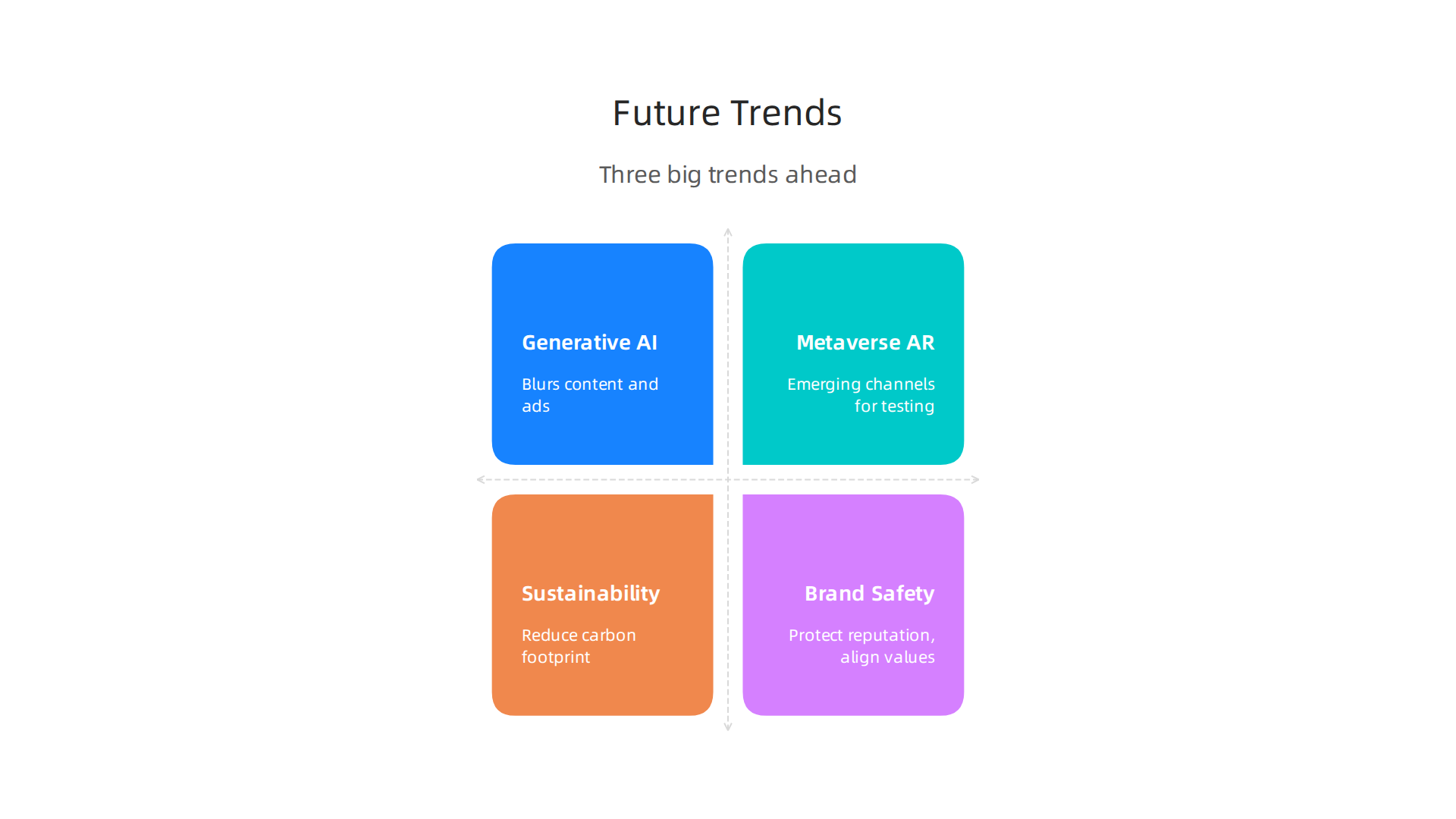
Knowing them now puts you ahead.
Generative AI Blurs the Line Between Content and Ads
Generative AI is making it harder to tell the difference between editorial content and advertising. Platforms like ChatGPT now serve sponsored results. Perplexity is testing ads inside answers. This creates a new native ad format that feels natural and helpful, not interruptive. By 2026, AI-powered search advertising already opened a new channel worth over $500 million a year. You can see the latest data on AI-powered search advertising trends in 2026 to understand how fast this is growing. The same technology lets brands create personalized ad copy, images, and even video at scale. That means more relevant ads for users and more efficient campaigns for you. But it also means you must be transparent. Laws in New York now require disclosures when ads use AI-generated performers. So as you lean into generative AI, keep compliance front and center.
The Metaverse and Augmented Reality Are Still Emerging
You have heard a lot about the metaverse and AR glasses. They are real channels, but adoption is still early. Most consumers are not living in virtual worlds yet. Smart advertisers are testing small budgets here to learn what works. For example, running AR filters on social media or placing virtual billboards in popular gaming spaces. These experiments help you build expertise without overspending. The key is to track performance honestly. Do not chase hype while your core channels like search, social, and CTV still drive the majority of returns. Use the freedom that native advertising with AI personalization gives you to test new formats without disrupting your main strategy.
Sustainability and Brand Safety Matter More
Consumers and regulators are paying close attention to where ads appear. If your brand shows up next to harmful or misleading content, you risk trust and revenue. At the same time, companies face pressure to reduce their carbon footprint. Digital ads use energy, especially programmatic auctions and video streaming. In 2026, more advertisers are choosing partners who offer carbon measurement tools. They are also setting strict brand safety standards using AI to scan placements in real time. These moves protect your reputation and align your spending with audience values.
The future of paid online advertising is not about a single trend. It is about combining generative creativity, careful experimentation, and responsible placement. Master these three areas, and you will stay effective no matter what changes next.
Summary
This guide walks through the paid online advertising landscape in 2026, explaining why the market’s rapid growth, fragmentation, and AI-driven automation make platform choice critical. It compares major ad channels (Google, Meta, Amazon, TikTok, LinkedIn) and emerging options like retail media and CTV, and it lays out clear selection criteria—campaign goals, budget needs, tech integration, and transparency. The article explains how generative AI and predictive bidding speed creative testing and improve targeting, and it gives practical budgeting, bidding, and measurement advice (including ROAS and incrementality). It also outlines privacy-first tactics for a cookieless world—first-party data, contextual targeting, clean rooms—and points to testing priorities for new formats. After reading, you’ll know which tools align with your objectives, how to set budgets and KPIs, and how to measure and scale compliant, high-performing campaigns.