
Analytic Marketing Drive Smarter Campaigns and Boost ROI in 2026
It’s 2026, and the media world is always changing. New online places pop up all the time, and old ones change how they work. For teams that handle ads and media, this means a lot of fast changes. One big problem is that valuable information often sits in different places. This makes it hard to see the full picture of how well recent marketing campaigns are doing. Also, there’s a lot of pressure to show that the money spent on these campaigns is worth it. People want to see clear results and a good return on investment (ROI).
This is where analytic marketing comes in. It’s about using data to understand what’s working and what’s not in your marketing efforts.

Think of it as a special way to collect and look at information from all your marketing activities to make better choices in the future. In fact, marketing analytics is the study of data to understand how well marketing activities perform, helping businesses make smarter choices and improve their campaigns What Is Marketing Analytics? (A Practical Definition).
It’s really the competitive edge that media teams need today.
If you want to keep up with all the new tools and changes, especially with AI influencing everything, it’s key to stay informed. Get clear daily AI updates from The AI Newsletter Worth Reading.
This guide will give you a simple, step-by-step plan. You’ll learn how to measure your recent marketing campaigns better, get clearer ideas from all your data, and make your best marketing campaigns even stronger. We’ll show you how to draw better insights and improve your overall performance. Knowing how to choose the right digital marketing platforms in 2026 is also a big part of this. By the end, you will have a clear framework to help your media team succeed.
In 2026, understanding your marketing numbers is more important than ever. Analytic marketing takes what might seem like small actions, like someone seeing your ad or clicking on a link, and turns them into big, clear pictures of how your business is doing. It’s like having a special map that shows you exactly how your marketing efforts lead to real results, like making sales or finding new customers.
Think about it this way: your team sets goals, right? Maybe you want more people to know about your brand or to buy your product. Analytic marketing connects those goals to how you measure success. It helps you see which of your recent marketing campaigns are truly making a difference. It also helps you understand why some campaigns work better than others, so you can make smarter choices for the future.
Get the Most from Your Marketing Efforts
Using analytic marketing brings many good things to your media campaigns:
- Spending Money Wisely: Imagine you have a certain amount of money to spend on advertising. Without analytic marketing, you might just guess where to put it. But with good data, you can see exactly which ads or online market research platforms bring in the most customers. This helps you put your money where it works best. You stop wasting money on things that don’t give you much back. It’s about being really smart with your budget and making sure every dollar helps your business grow.
- Making Ads Better: How do you know if your ad pictures, words, or videos are good? Analytic marketing gives you the answers. It shows you what people like to see and click on. This means your team can make creative ads that really connect with your audience. You can test different ideas and then pick the very best marketing campaigns based on what the data tells you. This constant improvement helps your messages stand out in a busy world.
- Learning About Your Audience: Over time, analytic marketing helps you learn a lot about the people you want to reach. What do they care about? What kind of content do they enjoy? This deep understanding helps you plan future campaigns that speak right to their needs and wants. It’s like having a secret helper that tells you what your audience is thinking. This is key for making sure your campaigns work well for a long time. For example, knowing how to choose a campaign type strategy how to pick the right marketing campaign for real ROI can be a game-changer.
By focusing on analytic marketing, media teams can move from just hoping their ads work to knowing exactly what brings results. It’s the path to clearer decisions and stronger marketing success in 2026.
For your marketing to truly shine, just knowing what analytic marketing is isn’t enough. The next big step is to set clear goals for what you want to measure.

This means picking the right Key Performance Indicators (KPIs), setting targets, and using smart frameworks to guide your efforts.
Setting clear measurement goals: KPIs, targets, and frameworks
Think of KPIs as the scoreboards for your marketing game. They are special numbers that show you if you are winning or losing. But it’s super important to pick the right KPIs. Some numbers just look good but don’t really help your business grow. These are called "vanity metrics." For example, having many "likes" on a social media post might feel good, but if those likes don’t lead to more customers or sales, they might not be the most important KPI for your business goal.
In 2026, smart marketers choose KPIs that directly connect to what the business wants to achieve. If your business wants to sell more products, then your KPIs should show how many sales your recent marketing campaigns brought in, not just how many people saw your ad.
Every KPI you pick should tie back to a main business goal, like getting more customers or making more money. This way, you track what truly matters. Experts suggest focusing on only a few important KPIs, perhaps 5 to 7, so you don’t get lost in too much data.
To make sure your KPIs are helpful, you can use a simple tool called the SMART framework.
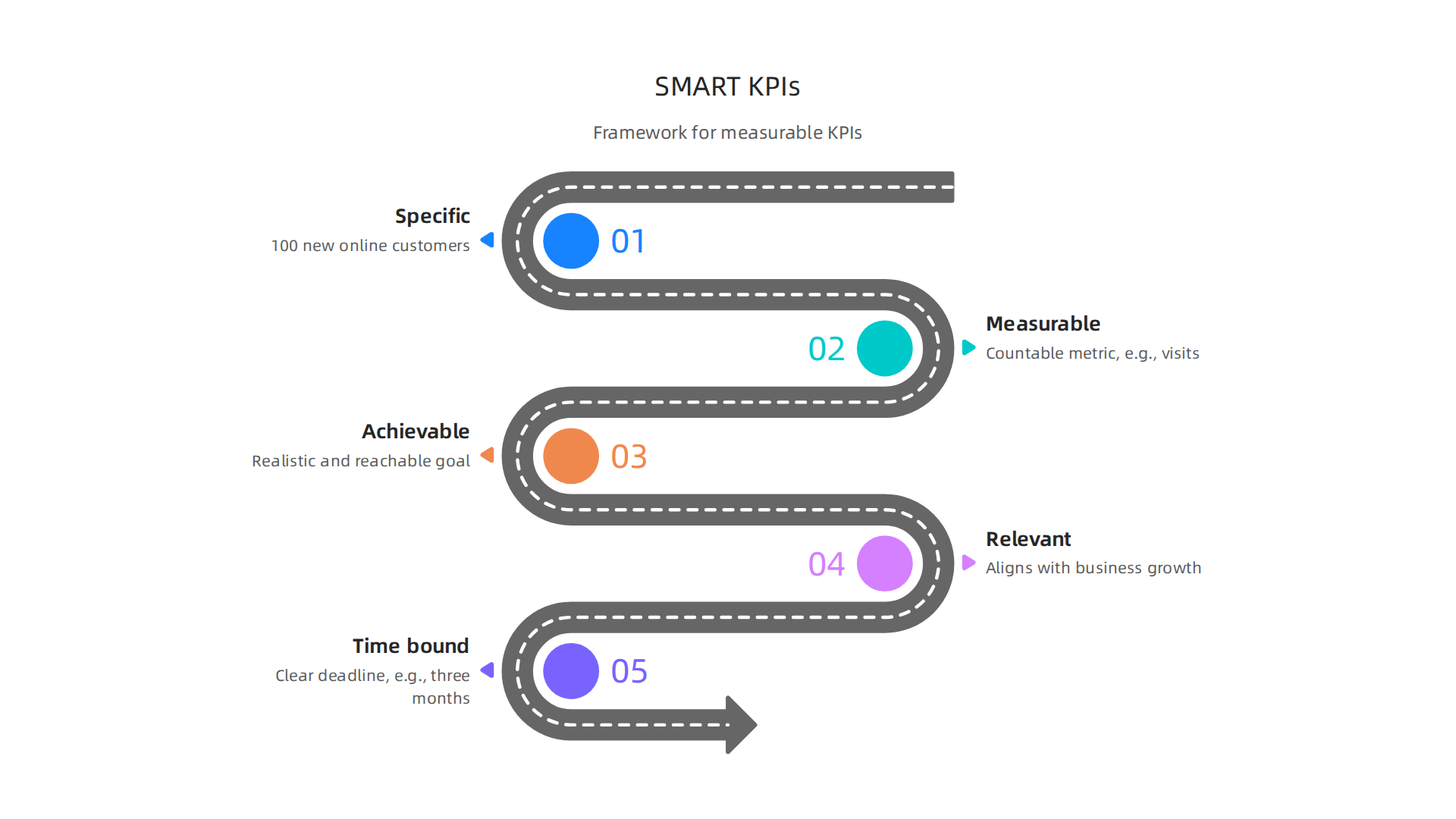
This means your goals should be:
- Specific: Not just "more sales," but "100 new online customers."
- Measurable: You can count it, like website visits or new sign-ups.
- Achievable: It’s a goal you can realistically reach.
- Relevant: It truly helps your business grow.
- Time-bound: It has a clear deadline, like "by the end of the next three months."
Using the SMART framework helps you set goals that make sense and can actually be tracked. This is key for creating a strong marketing campaign measurement plan.
Beyond SMART goals, there are other ideas to help you think about your targets. One is the "North Star Metric." This is one single, most important number that shows if your business is growing in the right direction. For example, a social media company’s North Star Metric might be how much time people spend on their app each day. It helps everyone on the team focus on the same big goal.
Another useful idea is to think about "leading" and "lagging" indicators.
- Leading indicators are things you can track now that tell you what might happen in the future. For instance, if many people click on your ad (a leading indicator), it might mean you’ll get more sales later (a lagging indicator).
- Lagging indicators show what already happened. Sales numbers are a lagging indicator because they show past results.
By tracking both, you get a full picture. You can see how your current actions might lead to future success, helping you adjust your strategies on the fly. This kind of careful planning helps you get the most out of your online market research platforms and all your data.
In today’s fast-paced media world, staying updated on the latest shifts in technology is crucial for setting effective marketing goals.
Get clear daily AI updates from The AI Newsletter Worth Reading.
When you link your KPIs to your business goals and use these frameworks, your team can make much smarter choices for all your best marketing campaigns. It turns analytic marketing from just looking at numbers into a powerful tool for real success.
To truly stay updated and reach those goals, you need the right tools. Think of your analytic marketing as a car race. Setting goals is like knowing where you want to finish. But to get there, you need a good car with the right gadgets to measure your speed, fuel, and how you’re driving. In 2026, there are many tools that help you do just that.
Choosing the right analytics tools and data sources is a big step. Different tools do different jobs, so it helps to know what each kind is for:
- Analytics Platforms: These are like your main dashboard. They show you what’s happening on your website, app, or with your marketing. Popular ones in 2026 include Google Analytics 4, which is free but mostly for the Google world, and Adobe Analytics for bigger companies. Many of the best marketing analytics software for 2026 fall into this group. They help track how well your recent marketing campaigns are doing.
- Tag Managers: These tools make it easy to add and manage all the small tracking codes (tags) on your website without needing a computer expert for every little change. It helps collect data smoothly.
- Customer Data Platforms (CDPs): These gather all the information you have about your customers from many different places. This gives you one clear picture of each customer, helping you understand them better.
- Business Intelligence (BI) Tools: These are super-smart report makers. They take lots of data from different sources, including your online market research platforms, and turn it into easy-to-read charts and graphs. This helps you find important patterns and insights.
- Creative Analytics Solutions: These special tools focus on your ads and content. They tell you which designs, pictures, or words work best to get people’s attention and drive results.
Choosing the right tools for your business can feel tricky. Here’s a simple checklist to help you pick the best ones:
- Where does the data come from? (Data Lineage): Can you easily see how the information got into the system? Knowing the path your data takes helps you trust your reports.
- Does it keep data private? (Privacy Compliance): Make sure the tool helps you follow important rules like GDPR. This is key to protecting your customers’ information.
- Can it talk to other tools? (Integration Surface): A good tool should connect well with all your other marketing tools, like your social media platforms or email service. Many top tools in 2026 offer strong multi-channel data integration.
- Is it easy to use? (Ease of Activation): How simple is it to set up and start getting useful information? You want a tool that’s easy to learn and use every day.
By carefully picking your digital marketing platforms in 2026 and data sources, you’ll set yourself up for truly effective analytic marketing. Tools like HubSpot Marketing Hub are known for their full set of features and connections, helping you run your best marketing campaigns with ease. Others, like Semrush, are great for specific jobs like checking your SEO and what your competitors are doing. Using the right mix of these tools makes sure you’re getting the most out of your data.
Once you have the right tools, the next big step in analytic marketing is to set up smart ways to test your ideas and see what truly works. This means designing experiments and figuring out how to give credit to the right marketing efforts. It helps you get reliable insights into your best marketing campaigns.
Designing Experiments for Clear Answers
To really know if a change you make helps or hurts, you need to run experiments. Two main types are very useful:
- A/B Tests: This is like trying two different versions of something to see which one works better. For example, you might show half your audience one ad (Version A) and the other half a slightly different ad (Version B). By comparing the results, you can see which ad gets more clicks or sales.
- Holdout Experiments: These are a powerful way to know if your marketing is truly causing more sales, not just happening at the same time as sales. A holdout test means you keep a small group of people from seeing a certain ad or campaign. Then, you compare their actions to a group that did see the marketing. This helps answer: "Would this outcome have happened even without this marketing?" For example, you might run a geo-holdout test where people in one city see your new ad campaign, but people in a similar city do not. Then you compare sales in both cities to see the true impact of your
recent marketing campaignsin the test city. Holdout tests can also be done by holding back ads from certain audiences or conversions. These types of tests are the only way to really prove cause and effect, instead of just seeing things that happen together, as explained by experts in marketing attribution.
Understanding Marketing Attribution
After your campaigns run, you need to know which parts of your marketing led to a customer taking action, like buying something. This is called attribution.
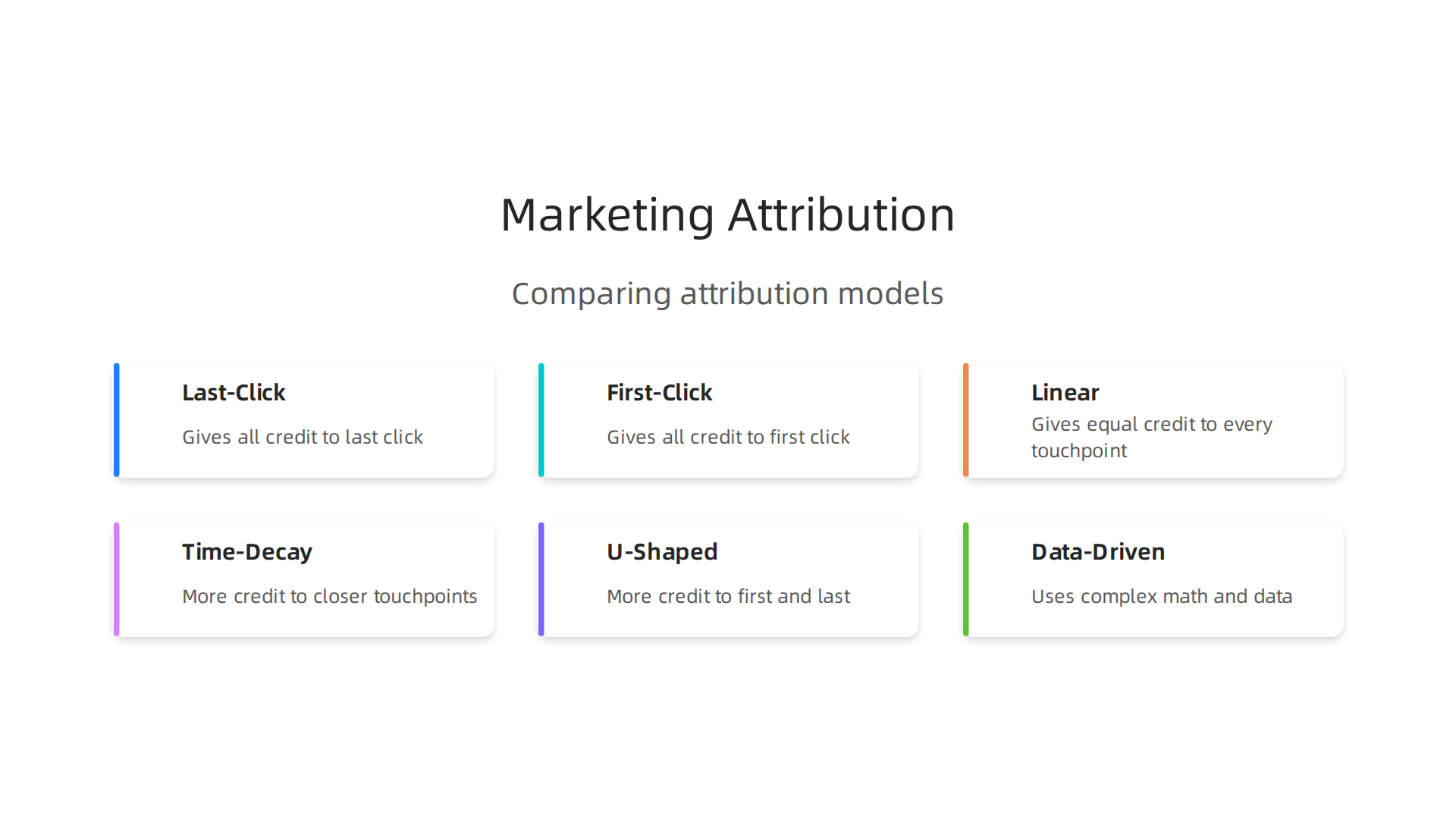
It’s tricky because customers often see many ads or pieces of content before they buy. There are different ways to give credit:
- Rule-Based Attribution: These are simple ways to give credit based on clear rules.
- Last-Click: This model gives all the credit to the very last thing a customer clicked before buying. It’s easy to understand but misses all the other steps along the way.
- First-Click: This gives all the credit to the first thing a customer saw or clicked that started their journey. It’s also simple but ignores everything that happened later.
- Multi-Touch Attribution: These models try to give credit to many different things a customer saw or clicked before buying. They offer a more complete picture than just first or last click.
- Linear: This model gives equal credit to every touchpoint a customer had.
- Time-Decay: This gives more credit to touchpoints that happened closer to the final action.
- U-Shaped: This model gives more credit to the first and last touchpoints, with less credit in the middle.
Using a multi-touch attribution model can help accurately credit all the steps that lead to a sale.
- Model-Based Attribution (Data-Driven): These are the smartest ways to give credit, often using complex math and data to figure out which touchpoints truly influenced a customer. These models look at all your data and try to understand the unique path each customer takes. Some advanced methods include Marketing Mix Modeling (MMM), which uses overall marketing spend to predict sales, and incrementality testing, which, as we discussed, directly measures actual impact. Combining different methods like multi-touch attribution for small changes and Marketing Mix Modeling for big budget decisions can give you a better overall view.
Each type of attribution has its own pros and cons. Simple rule-based models are easy to set up but can miss important details. More complex multi-touch and model-based methods give a better picture but need more data and skill to use. The goal of good analytic marketing is to understand which marketing efforts genuinely add value and help your business grow. For a deeper dive into improving your marketing campaigns, explore strategies for campaign type strategy.
To stay on top of the latest advancements that can make your analytic marketing even smarter, consider getting daily updates.
Get clear daily AI updates from The AI Newsletter Worth Reading.
Once you understand which marketing efforts actually lead to sales or other important actions, the real fun begins: making your campaigns even better. This is where analytic marketing turns into a powerful cycle of trying new things, learning from them, and then doing more of what works well.
The Cycle of Improvement: Hypothesis → Test → Learn → Scale
Think of improving your marketing like a science project. You have an idea, you test it, you see what happens, and then you use that information to make things even better.

- Hypothesis: This is your best guess. For example, "We think changing the color of the ‘Buy Now’ button to green will get more people to click it." Or, "Showing our new ad to people who have visited our website before will lead to more sales."
- Test: To check your guess, you run an experiment. As we talked about, you can use A/B tests to compare two versions of an ad, email, or webpage. Or you might use holdout experiments to see if your marketing actually causes more sales, not just happens at the same time. These tests help you understand the true impact of your
recent marketing campaigns. - Learn: After your test runs for a bit, you look at the numbers. Did the green button get more clicks? Did the new ad bring in more sales from your website visitors? This step uses all the data you collected to see what worked and what didn’t. Using tools that help track marketing analytics is key here, as they can show you how to improve your return on investment for your efforts, according to experts in marketing analytics tools.
- Scale: If your test shows that an idea works well, then you make that change bigger. Maybe you roll out the green button to everyone or show that successful ad to a wider audience. If an idea didn’t work, that’s okay too! You learned something new, and you can use that knowledge to come up with a different hypothesis for your next experiment. This helps you build
best marketing campaignsover time.
This cycle helps you continuously tweak and improve your marketing. You might try different ad pictures, new ways of writing your messages, or even show ads to different groups of people. Each small change, when tested and understood, helps you get closer to your best results.
Picking the Best Experiments and Handling Risks
You can’t test everything at once, and some tests cost more money or time than others. So, it’s smart to think about which experiments to run first:
- Focus on Big Impact: Start with tests that could make a huge difference if they work. For example, testing a completely new ad idea might be more impactful than just changing a single word in an old ad.
- Start Small: You don’t have to spend all your money on one big test. You can try out new ideas on a smaller group of people or in a limited area first. If it works, then you can put more resources into it.
- Use the Right Tools: There are many
online market research platformsand marketing analytics tools available in 2026 that can help you run tests, collect data, and understand results easily. Some platforms even use AI to suggest what to test next. For more on advanced techniques, learning about Performance Marketing 2026 can provide deeper insights. - Don’t Be Afraid to Fail: Not every idea will be a winner. That’s part of the process. Each "failed" test teaches you what doesn’t work, saving you money in the long run and guiding you toward what will.
By following this careful approach, you can make sure your analytic marketing efforts are always moving forward, helping your business grow steadily and smartly in 2026.
Once you’ve tried new things and learned what works for your business, the next big step is making sure everyone knows what’s happening and that your data stays clear and helpful. This is where good reporting, clear rules for data (called governance), and a smart team truly make your analytic marketing efforts shine.

Designing Dashboards and Reports That Drive Decisions
Imagine your business like a ship. The captain needs to know where they are going, how fast, and if there are any problems. In marketing, reports and dashboards are like that ship’s controls. They help different people in your company make smart choices.
First, think about who needs the information. A CEO might need a quick summary of how best marketing campaigns are doing overall, maybe once a month. A marketing manager might need more detailed daily or weekly reports on specific ad groups or emails to adjust them on the fly. Sales teams might need to see which campaigns are bringing in the most new customers.
Next, decide what information is most important. These are often called Key Performance Indicators, or KPIs. For example, how many people clicked an ad, how many bought something, or how much money was spent. It’s smart to write down the main decisions each person needs to make regularly, then choose metrics that help them with those decisions. According to experts, every important metric should have one person who understands it fully and is responsible for it Analytics Reporting Templates Stakeholders Use.
Finally, think about how often these reports are shared. Some might be daily emails, others weekly meetings, and some monthly summaries. The goal is to give people just the right amount of information at just the right time, so they can act on it without feeling swamped. Many companies in 2026 use structured marketing report templates to keep things consistent Marketing Report Template: Present Results That Matter in 2026.
Governance: Keeping Your Data Clean and Safe
"Governance" might sound like a big, fancy word, but for analytic marketing, it simply means having clear rules for how you collect, store, and use your marketing data. This is super important because bad data can lead to bad decisions.
Here’s what good data governance means:
- Data Quality: Making sure your data is correct and complete. This means having clear names for everything, checking that information is entered properly, and fixing mistakes quickly. Data governance frameworks in 2026 often include steps like assigning data owners and creating naming conventions A Practical Guide to Marketing Data Governance.
- Access Controls: Deciding who can see and use certain data. Not everyone needs to see all the details, especially sensitive customer information.
- Model Validation: If you’re using fancy tools or AI to predict things, you need to regularly check that these models are still working correctly and giving good advice.
- Cross-Functional Roles: Different people across your company need to work together to handle data. Some people might be "data stewards" who own specific sets of data, while others might be "data custodians" who handle the technical side of keeping data safe and sound Data Governance Framework for Marketing Analytics: A 2026 Guide.
Having these rules in place helps ensure that the insights from your recent marketing campaigns are always reliable. Without good governance, your beautiful reports might be telling you the wrong story.
Building an Analytically Driven Team
To truly make analytic marketing a core part of your business, you need the right people working together. This means building a team that understands data, knows how to ask good questions, and is ready to act on what they learn.
Here are some important parts of building such a team:
- Clear Roles: Everyone on the team should know what their job is and what they are responsible for. For example, one person might be great at running experiments on
online market research platforms, another at making reports, and another at explaining what the numbers mean. For more on the skills and trends for marketing roles, you might find our article on Marketing Manager 2026 roles skills and trends for success helpful. - Curiosity and Learning: An analytically driven team loves to ask "why?" and is always looking for new ways to understand customers and improve results. They’re not afraid to try new tools or learn new skills.
- Working Together: People from different departments, like marketing, sales, and product, need to talk to each other. This helps everyone understand the full picture and ensures that marketing efforts support overall business goals. Giving each important task a clear "Directly Responsible Individual" can help teams stay focused and accountable Marketing Team Structure Guide 2026.
By combining strong reporting, solid data rules, and a smart, curious team, your business can use analytic marketing to make better decisions, run best marketing campaigns, and grow steadily in 2026. For those wanting to stay ahead of the curve in this fast-changing field, especially with AI, there’s always more to learn.
Get clear daily AI updates from The AI Newsletter Worth Reading.
Summary
This article explains how analytic marketing gives media teams a clear, data-driven way to measure and improve recent marketing campaigns in 2026. It covers how to set meaningful KPIs that tie directly to business goals using SMART criteria and North Star thinking, and why you should focus on a short list of 5–7 metrics. You’ll learn which tool types matter—analytics platforms, tag managers, CDPs, BI tools—and a simple checklist for choosing vendors based on data lineage, privacy, integration, and ease of activation. The guide walks through experiments (A/B tests and holdouts), attribution methods (rule-based, multi-touch, model-based), and how to combine incrementality testing with Marketing Mix Modeling. It also shows the full improvement cycle—hypothesis, test, learn, scale—and how to prioritize experiments for impact and cost. Finally, it explains how to create decision-driving dashboards, enforce data governance, and build cross-functional teams that turn analytics into repeatable marketing wins.