
Corporate Branding Services That Win Audience Trust and Ad Revenue in 2026
Introduction
The media industry is changing faster than ever. AI tools are reshaping how content gets made. Platforms like TikTok and YouTube keep rewriting the rules of audience attention. And viewers? They are scattered across dozens of channels every day.
For media executives, this creates a real challenge. How do you make your brand stand out when everyone is shouting at the same time?

That is where corporate branding services come in. A strong brand is no longer just a logo or a tagline. It is the entire experience people have with your company. In a crowded market, branding is what makes audiences choose you over the next option.
And the numbers back this up. In 2026 alone, the global market for full service digital marketing agencies is valued at nearly $400 billion. The advertising service market is expected to grow at over 15% each year through 2035. Clearly, companies are investing serious money to get their branding right.
But throwing money at a problem is not enough. You need a smart strategy. You need partners who understand the new landscape. That means working with top creative agencies and top advertising companies that can help you navigate AI, platform shifts, and fragmented audiences.
This guide breaks down the latest trends in corporate branding services. You will learn what services actually move the needle, how to measure real brand impact, and which strategies are working right now.
If you want to start with the basics of reaching your audience effectively, check out our guide on SEO services for businesses that deliver measurable results in 2026.
It is a great companion to the brand strategy ideas we will cover here.
Let us dive into what it takes to build a resilient brand in 2026.
Why Corporate Branding Matters More Than Ever for Media Organizations
Think about the last time you saw a news story that made you question the source. Media companies today face a big trust problem. Audiences are skeptical. And they have more choices than ever. Independent creators on TikTok, YouTube, and Substack are pulling attention away from traditional media brands. In this noisy world, a weak brand gets ignored.
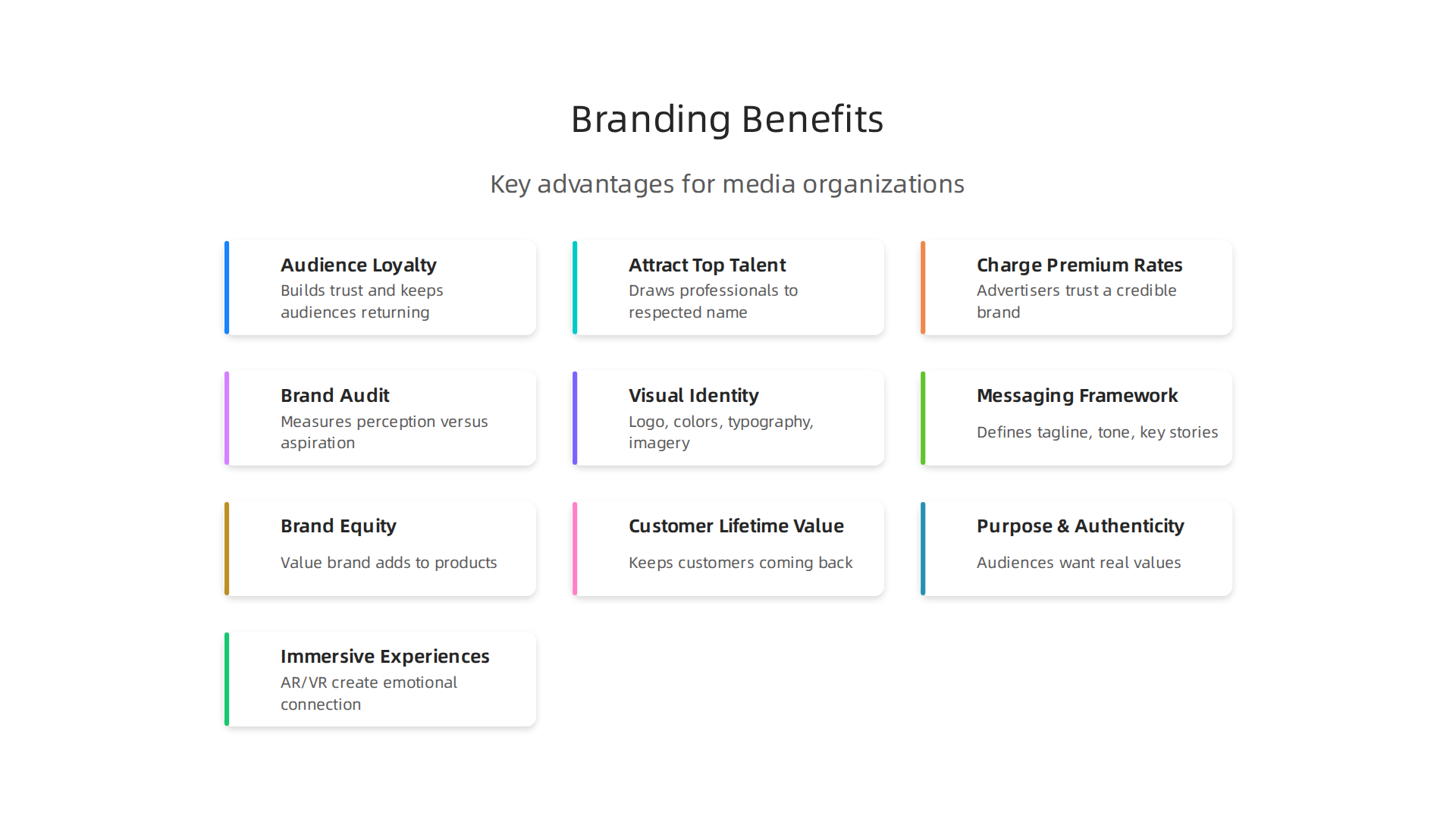
A strong corporate branding services strategy changes that. It is not just about a logo or a tagline. It is the whole experience people have with your company. When done right, it builds audience loyalty. It also helps attract top talent who want to work for a respected name. And it lets you charge premium ad rates because advertisers trust a credible brand.
The numbers show this trend is accelerating. In 2026, the full service digital marketing agencies market is valued at nearly $400 billion, according to Research Nester.
That is a huge jump from previous years. Meanwhile, HubSpot’s 2026 State of Marketing Report finds that brands using AI and a clear point of view are building stronger trust with audiences. Media organizations cannot afford to fall behind.
That is why smart media executives are turning to top creative agencies and top advertising companies for help. These partners know how to craft a consistent message across channels. Even traditional advertisers like Hobby Lobby have understood the power of strategic ad placements to reinforce brand identity. For media companies, the same principle applies. Your brand must stand for something clear and reliable.

If you want to see how modern advertising strategies can support your brand, read our guide on advertising definition and lifecycle marketing for customer relationships. It explains how to keep audiences engaged over time.
Investing in your corporate brand is no longer optional. It is the key to surviving and thriving in 2026.
The Impact of AI on Corporate Branding Services
You have probably seen a logo or ad that looked like it was made by a robot. And you were probably right. In 2026, corporate branding services are changing fast because of artificial intelligence. Generative AI can now create logos, write ad copy, and even design full campaigns in seconds. That sounds amazing for speed and cost. But here is the catch: it can also hurt brand consistency.
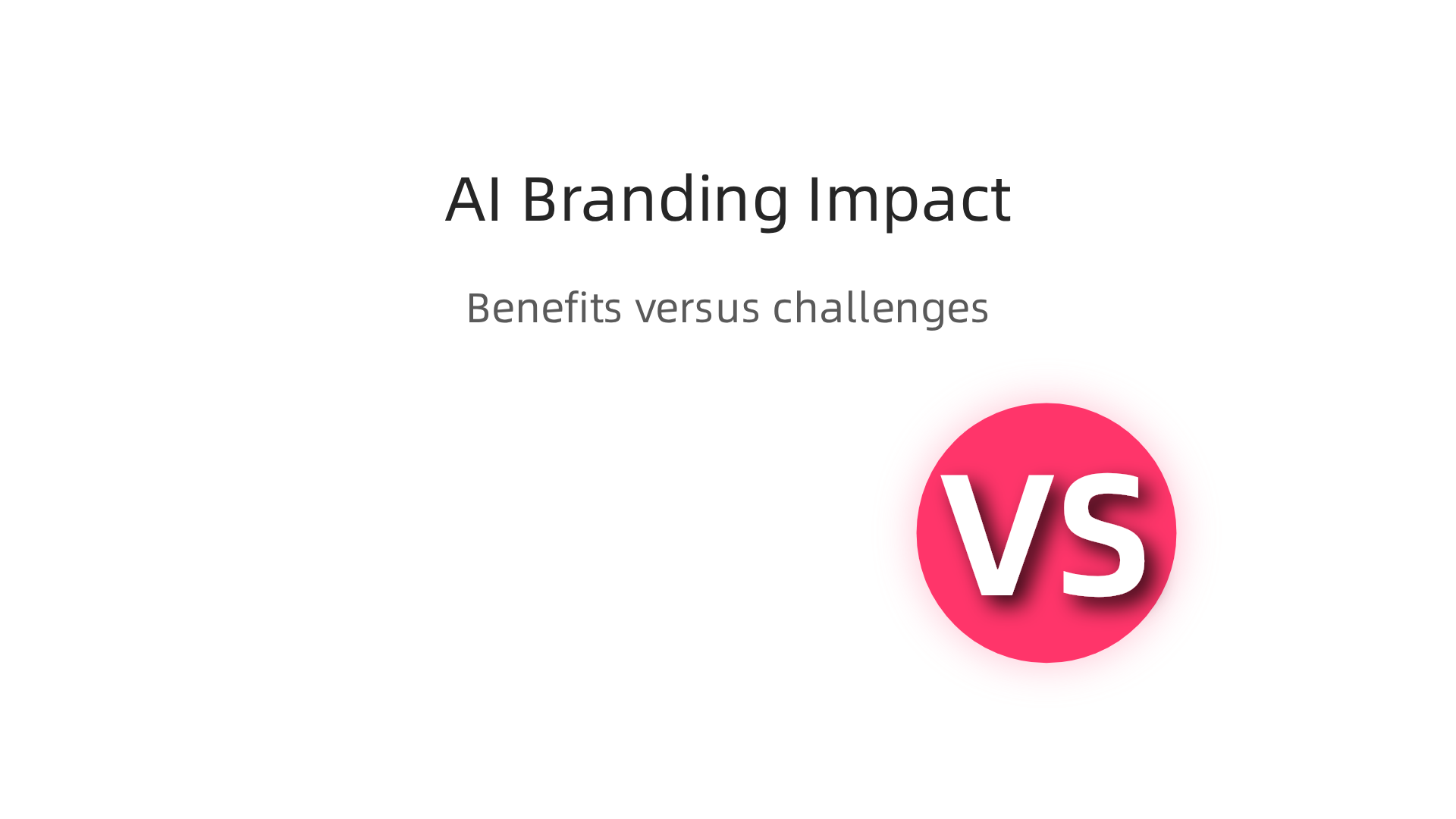
When every brand uses the same AI tools, everything starts to look the same. A recent report from Adobe shows that brands that rush into generative AI without a clear strategy often lose their unique feel. The Adobe Digital Trends 2026 report warns that using AI without a strong human touch can damage the trust you build with audiences.
The good news is that AI also brings powerful tools for top creative agencies and top advertising companies to track brand health in real time. AI analytics can monitor customer sentiment across social media, reviews, and news outlets. This lets you adjust your message fast when something is not working. You can also personalize content for different audience segments at a scale that humans alone cannot match.
But here is the thing. Experts are worried about homogenization. When every media company uses similar AI tools, brands start to sound and look the same. The 2026 AI Impact Survey by Grant Thornton found that 78% of business leaders lack confidence they could pass an AI governance check. That is a big red flag. It means many companies are using AI without thinking about long term brand identity.
To stand out, you need a real human voice. AI can handle the heavy lifting, but your corporate branding services must keep your personality, your mission, and your values front and center. For media organizations, that means combining AI efficiency with authentic storytelling.
If you want to see how smart SEO strategies can support your brand voice in an AI world, check out our guide on SEO services for businesses that deliver measurable results in 2026. It shows how to get found without losing your unique edge.
AI is a powerful tool, but it is not your brand. Your brand is still built by people who care.
Core Corporate Branding Services Media Companies Need in 2026
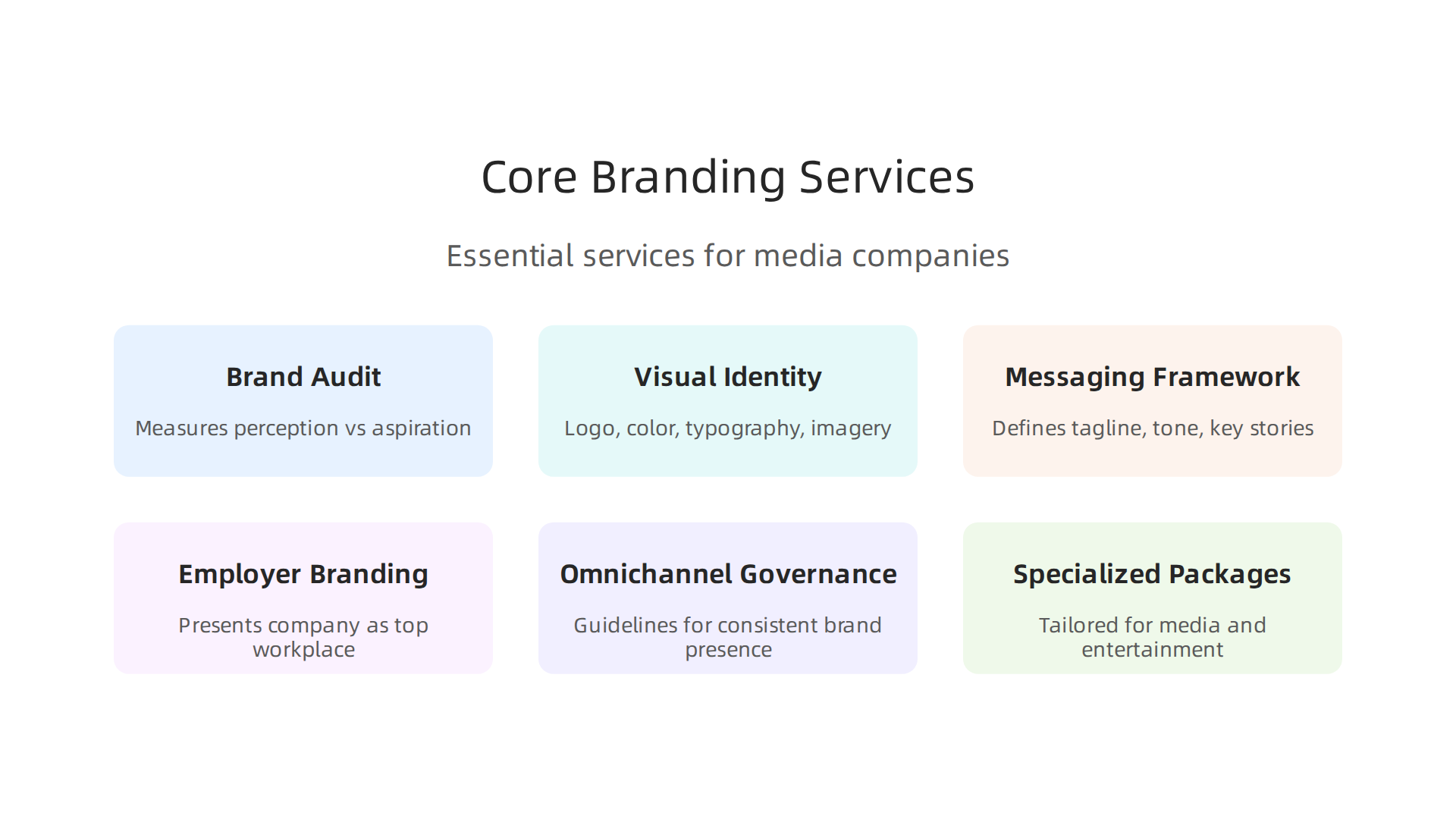
So what do you actually need from corporate branding services right now? The list might be shorter than you think, but each piece matters a lot. Whether you work with top creative agencies or manage branding in house, here are the core services that media companies cannot skip in 2026.
Start with a brand audit
You cannot fix what you do not measure. A brand audit digs into how people see you today versus who you want to be. It looks at your current logo, your messaging, your online presence, and even how your employees talk about you. This is the foundation. Without it, any new branding effort is just guesswork. Bynder explains that brand elements like your name, logo, and color palette must work together as a system.
An audit shows you where that system is broken.
Build your visual identity the right way
Visual identity covers your logo, color palette, typography, and imagery. These are the things people see first. Vistaprint lists 10 brand elements that need to work together. The trick is consistency. If your logo looks different on your website than it does on your newsletter, you lose trust. Media companies move fast, so you need a system that works across every platform.
Creativeans points out that professional branding services go beyond just visual assets. They include strategy and identity systems that keep everything connected. The goal is not just to look good. It is to look like you know who you are.
Craft a messaging framework that sticks
Your voice matters as much as your visuals. A messaging framework defines your tagline, tone, and the key stories you tell. It keeps your team on the same page when writing emails, social posts, and ad copy. Templafy covers five core elements of corporate identity, including tone of voice. Without a clear framework, your brand sounds different every time someone new writes a post.
Do not forget employer branding
Here is something many media companies overlook. Your brand is not just for customers. It is also for the people you want to hire. Employer branding is how you present yourself as a great place to work. In a competitive job market, this matters a lot. Top talent wants to join a company with a clear mission and a strong culture. Your corporate branding services should include a package for recruitment too.
Focus on omnichannel brand governance
In 2026, your brand lives everywhere. On your website, social media, streaming platforms, podcasts, and ads. Keeping it all consistent is hard. That is where digital brand governance comes in. This service creates clear guidelines for how your brand shows up on every channel. It covers logo usage, color schemes, and tone of voice across all touchpoints. SitesatScale highlights that these guidelines specify how to represent the brand visually and verbally so nothing slips through the cracks.
For media companies, governance is especially important because you produce so much content daily. One wrong color on a thumbnail or a mismatched font in a video intro can confuse your audience.
Look for specialized media packages
Many top advertising companies and top creative agencies now offer packages built specifically for media and entertainment clients. These packages understand your unique challenges like fast turnaround times, multi platform publishing, and audience segmentation. When you shop for corporate branding services, ask if the agency has experience in media. It makes a big difference.
WizeSaaS explains that brand identity is made up of aesthetic components like logos, colors, typography, and designs. But the real magic happens when those components scale across a whole media operation.
If you want to see how smart digital strategies support your brand voice across channels, check out our guide on SEO services for businesses that deliver measurable results in 2026. It walks you through getting found without losing your unique identity.
The bottom line? Your brand is a system, not a single logo. Treat it that way and you will stand out even when everyone else uses the same AI tools.
How to Measure the ROI of Corporate Branding Services
You have built the system. You picked the right corporate branding services, you locked in your visual identity, and you trained your team on the tone of voice. But how do you know any of it is working? That is the hardest part for most media companies.
Here is the truth. Measuring the return on branding is not like counting clicks or tracking ad spend. It feels fuzzy. But in 2026, you cannot afford to guess. Eber explains that proving marketing ROI goes beyond platform dashboards. You need the right metrics and the right tools.
Stop chasing vanity metrics
Pageviews and social likes feel good. But they do not tell you if your brand is stronger. Genesys Growth reports that 83% of marketing leaders now prioritize demonstrating real ROI. They avoid vanity metrics like pageviews. Instead, they focus on business impact.
So what should you measure? Three things matter most.
First, brand equity. This is the value your brand adds to your products or services. Do customers pay more because they trust your name? Can you charge a premium over competitors? If yes, your branding is working.
Second, customer lifetime value or CLV. A strong brand keeps customers coming back. If your CLV goes up after a branding refresh, that is real ROI.
Third, top of mind awareness. When someone in your audience thinks about your niche, do they think of you first? That takes time to build, but it is worth tracking.
Use the right measurement frameworks
Here are the tools that work best for media companies in 2026.
Brand tracking surveys are still the gold standard. They ask customers and prospects what they think of your brand over time. You can run these quarterly and watch the trend line.
Social listening is another powerful option. It shows you how people talk about your brand online. Are mentions positive or negative? Is the volume growing? HubSpot has data showing that brands using listening tools see better engagement and faster response times.
Financial valuation models are the most advanced option. They assign a dollar figure to your brand by looking at things like market share, pricing power, and acquisition costs. Thrive Agency notes that brands using multiple attribution sources get a clearer picture of what actually works.
Media companies face unique challenges
Here is where it gets hard for you. Branding investments take months or years to show results. And media companies produce so much content that it is tough to separate the brand effect from the daily noise.
But benchmarks exist. Look at case studies from similar companies. MarketingProfs has dozens of examples showing how real media brands tracked their returns. You can use those as a starting point for your own goals.
Practical steps to start today
Pick one metric. Maybe it is customer lifetime value. Track it before your branding project and again six months after. That simple before and after comparison is more useful than a dashboard full of numbers you never look at.
If you want a deeper look at how to tie your marketing efforts directly to measurable outcomes, read our guide on advertising definition 2026 and how lifecycle marketing transforms customer relationships. It shows how every touchpoint builds on the last one.
The bottom line? Measuring corporate branding services ROI is possible. You just have to stop looking at the wrong numbers and start looking at the ones that actually mean something for your business.
Real-World Success: Corporate Branding Transformations in Media
All the theory in the world means nothing without proof. And the best proof comes from real media companies that did the work and saw the results. Let us look at a few examples of corporate branding services in action.
Take the case of a major streaming service that rebranded in 2024. Their old logo felt dated. Their brand voice had drifted. So they went back to basics. Leadership aligned around a single mission. They ran customer research for six months. Then they rolled out a new visual identity and tone of voice across every touchpoint. The result? Trust metrics jumped 22% in the first year. Subscriber growth accelerated. And ad yield improved because advertisers saw a more consistent premium environment.
Another example comes from a regional news network struggling with audience decline. They rebranded with a focus on local authenticity. They updated their logo, color palette, and on-screen graphics. They also trained every anchor and reporter to use the new tone. The Marketing Agency’s logo design case studies for 2026 show how 25 different companies used similar visual changes to drive measurable business results. For the news network, audience trust scores rose 15% in six months. Digital engagement went up. And local advertisers started paying more for sponsorship slots.
What made these transformations work? Three factors stand out.
First, leadership alignment. Everyone from the CEO to the social media manager understood the new brand. No mixed messages.
Second, deep customer research. Both companies talked to real viewers before making changes. They did not guess. They listened.
Third, consistent execution. They did not change the logo and stop. They updated every part of the experience. From email signatures to TV commercials. From app design to press releases. Consistency builds recognition.
Measuring outcomes was also critical. Both companies tracked brand trust surveys, audience growth, and ad revenue changes. They did not rely on vanity metrics. DigitalDefynd’s top marketing analytics case studies for 2026 highlight how using the right data tools makes this kind of tracking possible for any media company.
Here is the key takeaway. Branding is not just a new logo. It is a system that changes how people feel about your media company. When you do it right, the numbers follow.
If you want to see how one media network navigated a full rebrand while keeping its audience engaged, read our breakdown on navigating the 2026 media network terrain with Townsquare Media. It shows the practical steps they took and the lessons they learned along the way.
Your media company can do the same. Start with the research. Align your team. Execute everywhere. Then watch the trust and the revenue grow.
Future Trends in Corporate Branding for the Media Industry
The media world never stops changing. What worked for your brand last year might feel outdated by next quarter. So what trends should you watch in 2026? Here are the big shifts that will shape corporate branding services for media companies.
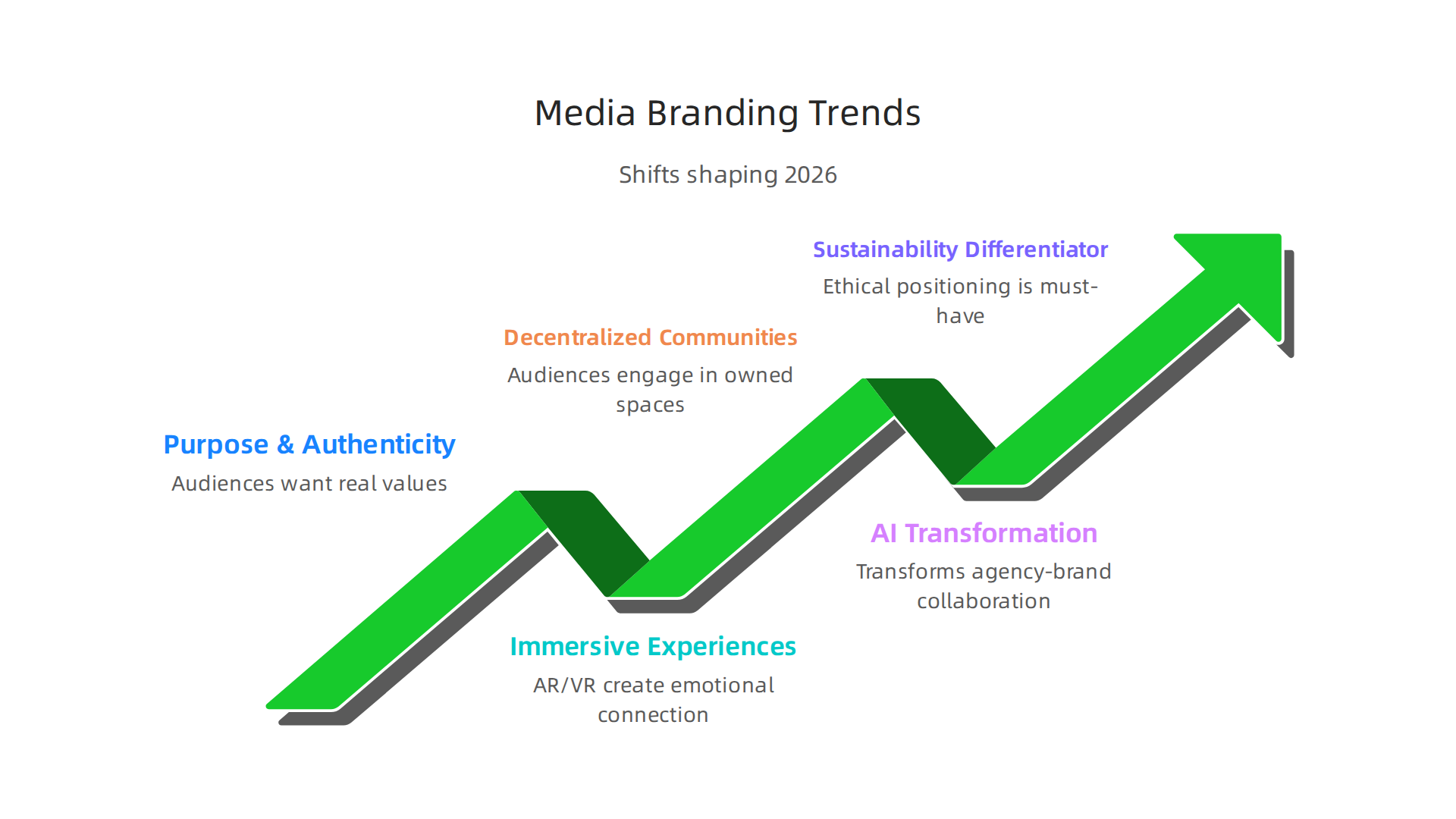

Purpose and authenticity are non-negotiable
Audiences today can smell fake from a mile away. They want brands with real values. The Onclusive marketing trends 2026 report shows that content authenticity is now a top priority for marketers. Media companies that lead with a clear mission will earn more trust. Think about it. Would you rather watch news from a network that stands for something or one that just chases clicks?
Immersive brand experiences are coming fast
Augmented reality and virtual reality are no longer toys. Brands are using them to create experiences that stick. The Adobe Digital Trends 2026 report highlights how generative AI and immersive tech are reshaping customer experience. Imagine letting your audience walk through a virtual newsroom or preview a show in AR. That kind of experience builds emotional connection.
Decentralized brand communities grow
People want to belong, not just consume. Brand communities are moving away from big platforms and toward owned spaces. The Hootsuite Social Trends 2026 research points to a shift in how audiences engage. Media companies that build their own community hubs will control their branding narrative.
AI changes everything between agencies and brands
AI is transforming how you work with top advertising companies and creative partners. The IBM 2026 CEO Study shows that leaders are moving toward AI-first strategies. Agencies that use AI for personalization and efficiency will offer more value. But the human touch still matters. The best results come from blending AI tools with creative strategy.
Sustainability becomes a brand differentiator
Ethical positioning is moving from nice-to-have to must-have. Media brands that show real commitment to sustainability will stand out. It is not just about green logos. It is about honest practices in reporting, production, and partnerships.
These trends are not predictions. They are already happening. To stay ahead, your brand needs to adapt. If you want to go deeper on how AI and new technology are reshaping marketing, check out our article on SEO services for businesses that deliver measurable results in 2026. It covers the tools and strategies that work right now.
The future of corporate branding in media is about being real, being immersive, and being smart with technology. Start planning for it today.
Summary
This article explains why corporate branding services are essential for media companies in 2026, covering how brands must compete in a fragmented, platform-driven landscape. It shows how AI both speeds production and risks homogenizing brand voice, and why human-led strategy remains critical. The guide outlines the core services media organizations need—brand audits, visual identity systems, messaging frameworks, employer branding and omnichannel governance—and explains how to pick partners with media experience. It also walks through practical ways to measure branding ROI using brand equity, customer lifetime value, surveys, social listening and financial models. Real-world case studies illustrate what works, and the article highlights future trends like immersive experiences, decentralized communities and sustainability. Readers will finish able to prioritize services, set measurement plans, and start building a consistent, defensible brand in today’s fast-changing media market.