
Navigating the 2026 Media Network Terrain with Townsquare Media
Introduction: Navigating the New Media Network Terrain
If you work in media, you have probably felt the shift. The way people find news, listen to radio, and interact with advertisers has changed fast. And it keeps changing.
In 2026, the media network space is going through a major shakeup. Big companies are buying smaller ones. Digital channels are taking over. And local media companies are trying to find their place in a national or even global market. For media executives, the pressure to adapt has never been higher.

That is where Townsquare Media comes in. Townsquare Media has built a name for itself by keeping one foot in local communities and the other in digital growth.
In fact, digital revenue now makes up a record 59% of Townsquare’s total net revenue, according to their Q1 2026 earnings highlights. The company expects Q2 2026 net revenue to land between $114 million and $116 million.
But Townsquare is not the only player making moves. Networks like Range Media Partners, Cardenas Marketing Network, and GrowthScribe Marketing Agency are also finding ways to blend local reach with digital scale.

Each one brings a different approach. Some focus on live events. Others lean into data-driven advertising. The key is understanding where the real value lies.
This article gives you a practical look at the current media network terrain. You will see how Townsquare Media compares with its peers. You will also learn where the biggest opportunities are hiding for smart media executives.
If you want to stay ahead of daily shifts in AI and media, Subscribe Free to The Deep View Newsletter. It delivers clear, daily insights so you do not have to dig through the noise yourself.
Let’s get started.
The Rise of Multi-Platform Media Networks
So what does this new media network terrain actually look like? In 2026, no single channel is enough. Media networks must operate across broadcast, digital, social, and audio to keep up with how audiences consume content. The $88.7 billion advertising industry in the US has grown at a steady clip over the last five years, and much of that growth comes from companies that master this multi-platform approach.
Townsquare Media is a strong example of this pivot. Their "local first, national scale" model started in radio but now reaches audiences through live events, digital content, and streaming audio. Other players like Range Media Partners, Cardenas Marketing Network, and GrowthScribe Marketing Agency each take a different angle. Some lean into live events. Others focus on data-driven advertising. But they all share one thing: they understand that sticking to one channel is a losing bet.
For media executives, this macro shift matters a lot. When you evaluate partnerships or acquisition opportunities, you need to know whether a network can deliver across platforms.

The ones that can are the ones worth your attention.
Want to stay ahead of these shifts? Subscribe Free to The Deep View Newsletter for daily insights on AI and media.
Defining the Modern Media Network
So what actually separates a true media network from a content company in 2026? Four key pillars make the difference.
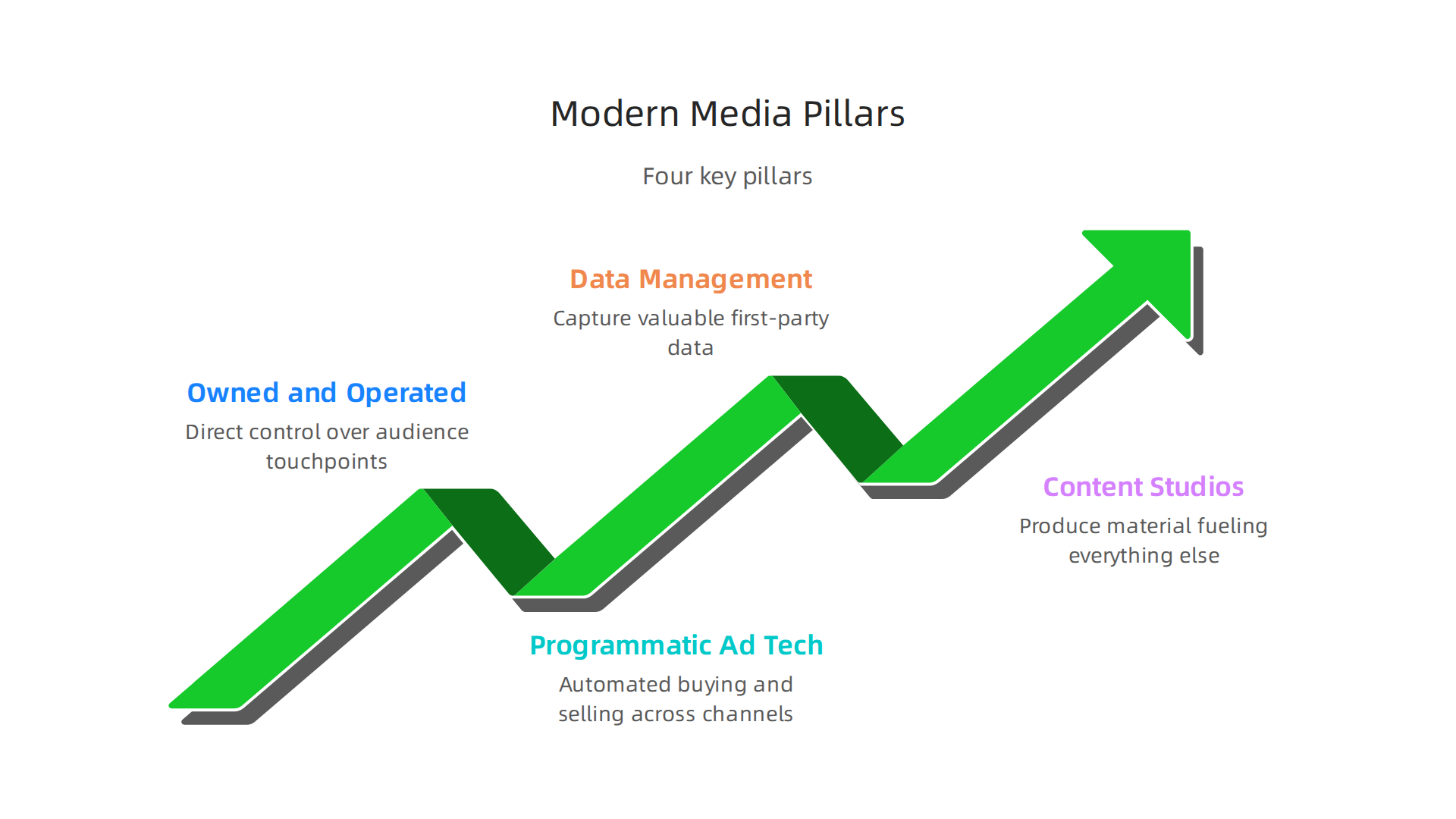
First, owned-and-operated properties give a network direct control over its audience touchpoints. Second, a programmatic ad tech stack allows automated buying and selling across channels. Third, data management systems capture valuable first-party data. Fourth, content studios produce the material that fuels everything else.
Townsquare Media demonstrates this model well. Its blend of radio, digital, and live events shows how owned properties combine with smart data use. Range Media Partners, Cardenas Marketing Network, and GrowthScribe Marketing Agency each build their own version of this stack too.
Today, networks get measured by two things above all: total reach and the depth of their first-party data. The US advertising industry hit $88.7 billion in 2026, and networks with strong data capabilities capture most of that spend.
Want to know which networks have a real data advantage? Get Free Updates from The Deep View Newsletter for daily AI and media insights.
Townsquare Media’s Local-to-National Strategy
Townsquare Media builds its network the opposite way from most media companies. Instead of starting national and trying to go local, it starts local and scales up. The company owns hundreds of radio stations in midsize markets across the US. Each station acts as a distribution hub for digital content, live events, and podcasts. This gives Townsquare deep roots in local communities while feeding a national advertising platform.
Acquisitions have accelerated that reach. Townsquare has bought podcast networks, live event companies, and digital ad tech firms. These purchases help it sell both local ad packages and programmatic campaigns to national brands. The result is a dual revenue stream: loyal local advertisers plus high-margin programmatic dollars from big agencies.
The numbers back up the model. In Q1 2026, digital revenue hit a record 59% of total net revenue, up from just over half the year before source. The company sees Q2 net revenue between $114 and $116 million and reaffirmed its full-year 2026 guidance source. Even with a slight revenue dip to $96.8 million, the shift toward digital shows this local-to-national strategy is working.
Want to follow networks like Townsquare as they reshape media? Subscribe Free to The Deep View Newsletter for daily AI and media insights.
AI and Automation Reshaping Media Networks
AI is changing the game for every media network, including Townsquare Media and its peers. Think about it: AI now handles content creation, distribution, and ad targeting faster than any human team could. But here’s the thing most networks are still catching up. Only 30% of agencies, brands, and publishers have fully adopted AI across their media campaigns, according to a recent Adtelligent report. And yet half expect to be there by the end of 2026
source. That gap is big news for smart buyers and sellers.
The numbers show why. Already, 35% of digital ads include AI personalization source. And the programmatic advertising market is expected to hit $237 billion by 2034 source. For networks like Townsquare, that means investing in AI-driven programmatic platforms and personalization engines is a must. Even audio, a sweet spot for local radio, has untapped potential: audio gets 31% of consumer media time but only 9% of ad budgets source. AI can help close that gap by making audio ads more targeted and measurable.
So what does this mean for you? Whether you’re at a network like Range Media Partners or an agency like Growthscribe Marketing Agency, you need to understand the AI adoption curve. Those who move early will win. Those who wait risk falling behind.
Want simple daily updates on how AI is reshaping media? Subscribe Free to The Deep View Newsletter. It’s the easiest way to stay ahead.
AI-Powered Content Distribution and Personalization
Dynamic ad insertion and AI-driven content recommendations are now standard for any serious media network. Townsquare Media’s digital audio network puts this into practice by using AI to optimize listener engagement in real time. The system learns what each audience member prefers and serves the right ad or segment at the right moment. This is a direct way to close the audio ad gap and boost revenue.
Others in the space see similar gains. Networks like Range Media Partners and agencies such as Growthscribe Marketing Agency or Cardenas Marketing Network can use these same tools to refine their own content strategies. As one analysis puts it, AI in advertising is now "improving targeting, personalizing content, and optimizing campaigns with precision" source.
Want to learn how these AI shifts affect your media buying decisions? Get Free Updates from The Deep View Newsletter.
Programmatic Advertising and Audience Targeting
Programmatic advertising now drives a growing share of revenue for networks like Townsquare Media. In fact, programmatic audio is set to claim about 30% of US digital audio ad spend source. The key to making this work? First-party data. By combining their own listener data with AI, networks can target audiences with much more precision. This reduces wasted impressions and boosts campaign performance.
Other players like Range Media Partners, Cardenas Marketing Network, and Growthscribe Marketing Agency are also leaning into these data-driven strategies. AI is reshaping how brands bid and segment audiences in real time source.
Want to stay ahead of these shifts? Get Free Updates from The Deep View Newsletter.
Monetization Strategies in 2026
Relying only on ad sales is risky today. Smart media networks are building multiple income streams. Townsquare Media, for instance, mixes digital advertising, live events, and podcast sponsorships.
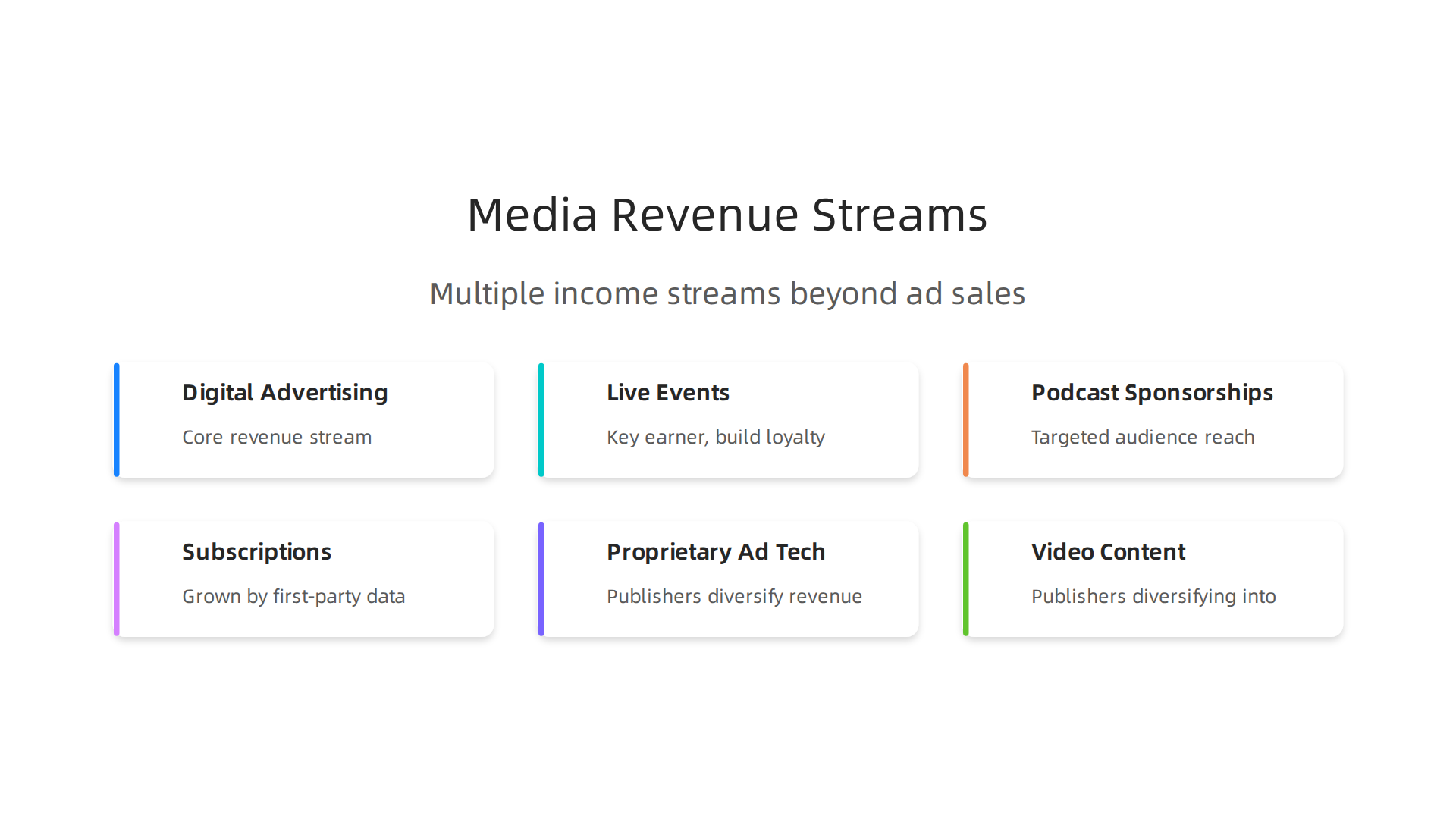
This approach helps them stay stable even when ad budgets shift.
Other networks like Range Media Partners, Cardenas Marketing Network, and Growthscribe Marketing Agency are also trying new revenue models. They use first-party data to grow subscriptions and sell event tickets. In fact, publishing trends for 2026 show that live events and outcome-based ads are becoming key earners.
Data plays a big role here. By understanding their audience, networks can create premium offers. Media brands use first-party data to find new subscribers and keep current ones happy. This works for everything from newsletter tiers to event passes.
Publishers are also diversifying into proprietary ad tech and video. For advertisers, knowing these models helps you place budgets where they work best.
Want to keep up with the latest revenue shifts? Subscribe to The Deep View Newsletter for daily insights.
Diversifying Revenue: Advertising, Subscriptions, and Events
Events are becoming a big profit center for smart media networks. Townsquare Media runs popular annual festivals and business expos in local markets. These events do two things well. They bring in real money from ticket sales and sponsor partnerships. And they build strong brand loyalty with the community.
According to Townsquare Media’s Q1 2026 results, digital revenue hit a record 59% of total net revenue. That shows how well the company blends traditional events with modern digital income. Audiences who show up for a festival often become loyal readers or listeners afterward.
Want to stay ahead of media revenue trends? Subscribe Free to The Deep View Newsletter for daily insights.
The Role of Data and First-Party Strategies
Events and subscriptions are great. But the real gold for media companies in 2026 is first-party data. As third-party cookies fade away, owning your audience data matters more than ever.
Companies like Townsquare Media pull data from their events, newsletters, and digital platforms to build detailed audience profiles. This data becomes a powerful asset in programmatic auctions, where advertisers pay premium rates for well-targeted inventory. According to a 2026 playbook for local media, better data improves targeting and also enhances packaging and yield. That means higher CPMs.
Building a robust data lake gives networks a real edge. Whether you work with Range Media Partners or a Growthscribe Marketing Agency, the principle stays the same. Own your data. Use it well.
Stay ahead of these data shifts. Subscribe Free to The Deep View Newsletter for daily insights.
Key Players in Media Networks: A Comparative Analysis
The media network landscape in 2026 is a mix of traditional powerhouses and new digital challengers. On one side, you have legacy radio groups like iHeartMedia, Cumulus, and Entercom (now part of Audacy). These companies still command huge audiences through broadcast and digital syndication. On the other side, digital-first entrants such as Spotify and Amazon Music are blurring old boundaries by combining music, podcasts, and programmatic advertising.
Within this crowded field, Townsquare Media stands out for its sharp focus on mid-sized markets and a diversified revenue model. While iHeartMedia leans heavily on national ad sales, Townsquare builds local connections through events, digital services, and first-party data. This approach gives it a unique edge in markets that bigger networks often overlook.
Newer players like Range Media Partners bring a talent-driven angle, while agencies such as Cardenas Marketing Network and Growthscribe Marketing Agency help brands navigate multicultural and content marketing opportunities. The largest content marketing agencies in the U.S. are also expanding into media services, further blurring the line between agency and network.
To put this in perspective, the top advertising groups like Omnicom and Publicis continue to reshape the industry through mergers and AI investments. But for media executives, the real question is which network model will deliver the best audience and revenue results in your specific market.
Want to track these shifts daily? Get Free Updates from The Deep View Newsletter for simple daily insights on media, AI, and audience strategies.
Townsquare Media vs. iHeartMedia vs. Cumulus vs. Audacy
When comparing these four radio giants in 2026, the differences come down to scale, financial health, and strategy.
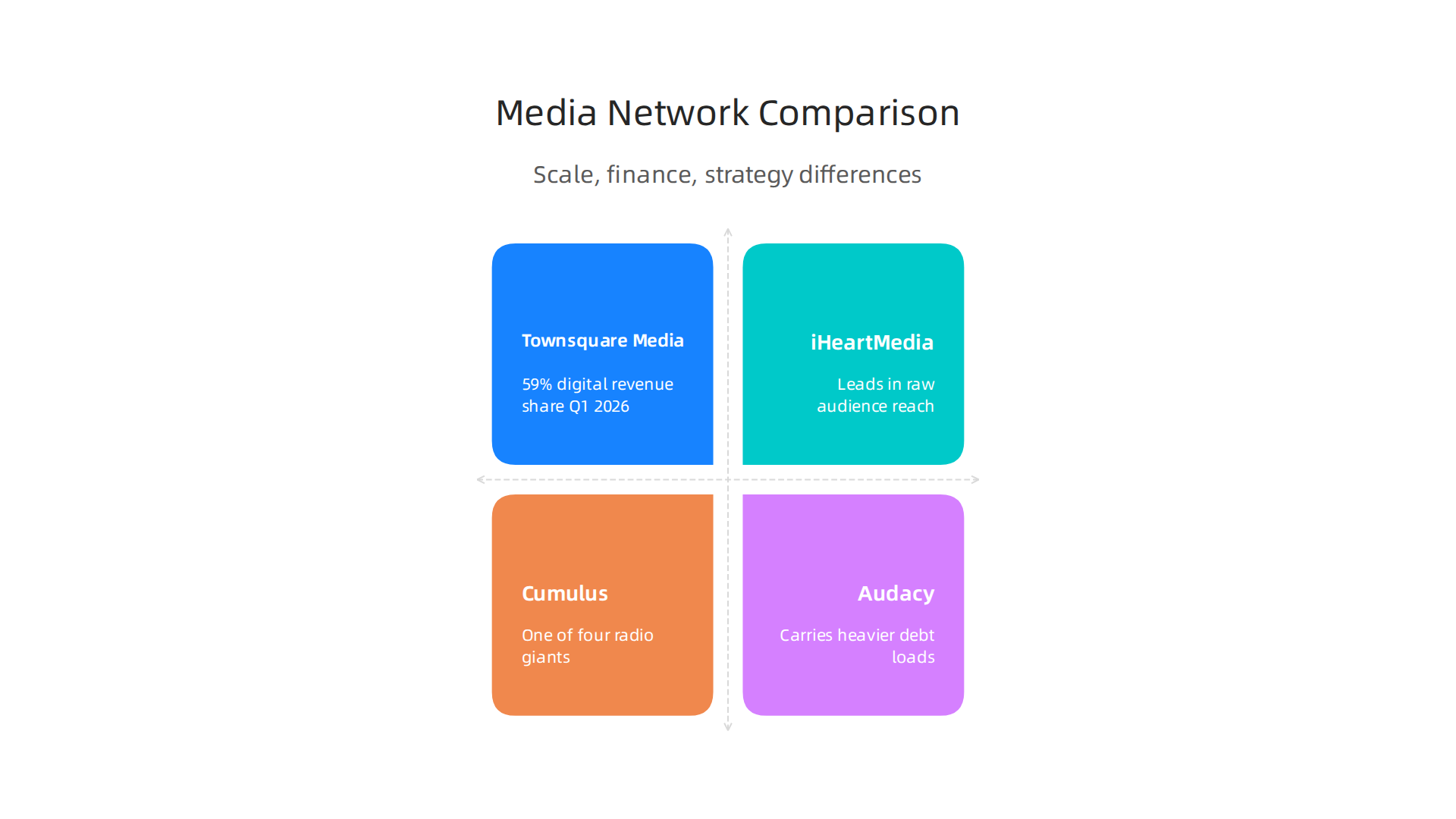
iHeartMedia still leads in raw audience reach. But Townsquare Media has something the others can’t match: a digital revenue share that hit 59% of total net revenue in Q1 2026, according to MarketBeat. Townsquare expects Q2 2026 net revenue between $114 million and $116 million, as Media Confidential reported.
Debt levels tell another story. iHeart and Audacy carry heavier loads, which limits their agility. Townsquare’s leaner balance sheet gives it room to invest in events and podcast partnerships. Meanwhile, newer players like Range Media Partners bring a talent-focused model, while agencies such as Cardenas Marketing Network and Growthscribe Marketing Agency offer specialized services for brands navigating multicultural and content marketing.
Each player approaches live events differently. iHeart leans on massive award shows. Cumulus and Audacy focus on local activations. And Townsquare builds community event franchises that drive both revenue and valuable first-party data.
Want daily media insights that cut through the noise? Subscribe to The Deep View Newsletter.
Emerging Digital-First Networks
While legacy players like Townsquare Media build their digital revenue share, a new wave of digital-first networks is changing the game. Podcast networks such as SiriusXM and iHeartPodcasts now operate at massive scale. Creator platforms and talent-focused models from companies like Range Media Partners are also redefining what a media network can look like.
These newcomers often lack the local radio presence of traditional broadcasters. But they make up for it with something powerful: data. They use audience insights and personalization to deliver targeted advertising in ways older formats struggle to match. The broader U.S. marketing agencies market, worth $192.45 billion in 2026 according to Mordor Intelligence, shows how much room there is for specialized players. Agencies like Cardenas Marketing Network and Growthscribe Marketing Agency bring focused expertise in multicultural and content marketing, proving that digital-first thinking is the new standard.
Stay ahead of these media shifts with clear daily updates. Get Free Updates from The Deep View Newsletter.
The Creator Economy and Podcasting
Podcasting has become a powerhouse in 2026. Global ad revenue for podcasts and vodcasts is expected to reach $5 billion this year, up 20% year over year according to Deloitte via Podnews. In the US, podcast ad spend is projected to exceed $3 billion this year per the IAB Podcast Ad Revenue Report. Advertisers now treat podcasting as a core channel for reaching engaged audiences.
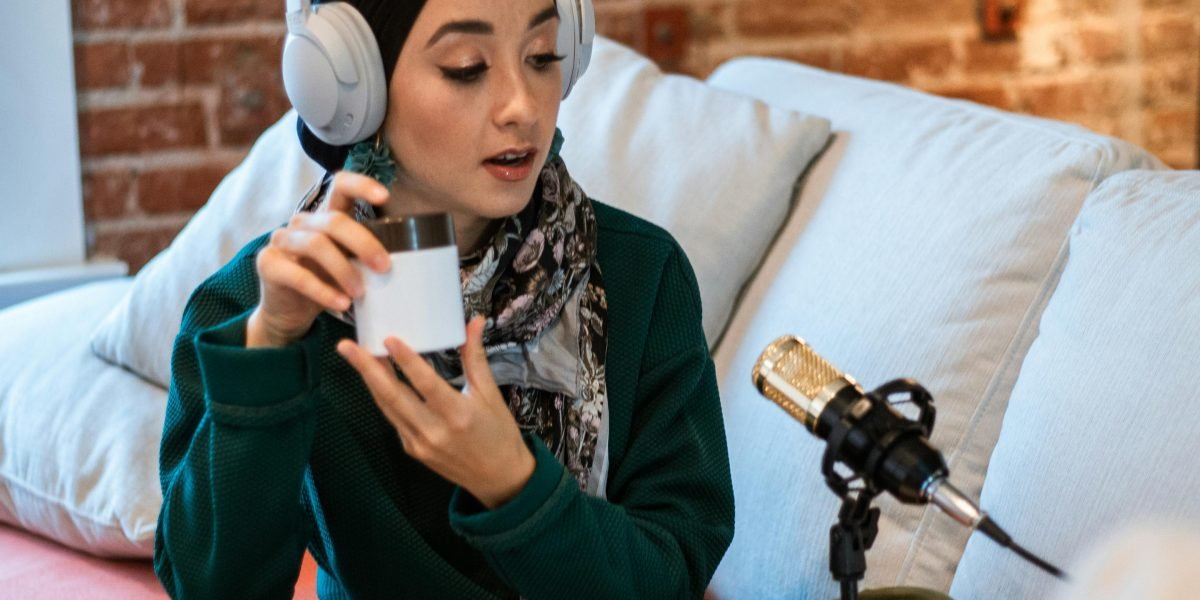
Townsquare Media has been quietly expanding its podcast network. Through strategic acquisitions and original programming, the company is building a strong on-demand audio presence alongside its existing local radio stations. This dual approach gives advertisers more options: traditional broadcast reach plus the targeting power of digital audio.
Influencer partnerships are also fueling growth for media networks. Companies like Range Media Partners are showing how connecting talent with brands generates serious revenue. Many traditional broadcasters are following their lead, working with creators to reach younger, harder-to-find audiences.
For media professionals trying to keep up with these rapid changes, having a trusted source of daily insights makes all the difference.
Subscribe Free to The Deep View Newsletter for clear, daily coverage of podcasting, creator trends, and media strategy.
Podcasting as a Growth Driver for Townsquare
Townsquare Media is putting this trend to work. The company has invested heavily in dedicated podcast studios and programmatic ad insertion for audio. This lets advertisers buy targeted podcast spots as easily as digital display ads. Local talent from their radio stations now cross-promote their own podcasts, extending reach beyond broadcast airwaves.
These moves are paying off. In Q1 2026, digital revenue hit a record 59% of total revenue, with the company expecting Q2 net revenue between $114 million and $116 million according to MarketBeat. Podcasting isn’t just a side project for Townsquare. It’s becoming a core growth engine alongside traditional radio.
Want to stay updated on how podcasting is reshaping media companies like Townsquare? Get Free Updates from The Deep View Newsletter for daily insights on audio strategy and creator trends.
Influencer Partnerships and Branded Content
Townsquare Media doesn’t just produce its own shows. The company also connects local influencers with advertisers who want real, trusted recommendations. Acting as a middleman, Townsquare helps local talent turn their audience into income through branded content.
Why does this matter? Local influencers offer hyper-targeted engagement. A familiar voice talking about a nearby business often outperforms a generic national ad. This creates a win for the creator, the brand, and the network.
While large firms like Range Media Partners manage top national talent, Townsquare focuses on building local voices. Agencies like Growthscribe Marketing Agency help track this engagement. In a way, it is similar to how the Cardenas Marketing Network connects brands with specific event audiences.
The US podcast advertising market reached $4.2 billion in 2026, with the global industry valued at $28.6 billion according to Searchlab. Branded content is a huge piece of that growth.
Want to stay on top of how networks are building influencer partnerships? Subscribe today for daily insights from The Deep View Newsletter.
Future Outlook: Local Media, Regulation, and Innovation
The growth we are seeing in influencer partnerships and branded content is just the beginning. Local media is experiencing a real renaissance in 2026. Why? Because community trust is hard to beat. People want news and recommendations from voices they know and see in their own towns.

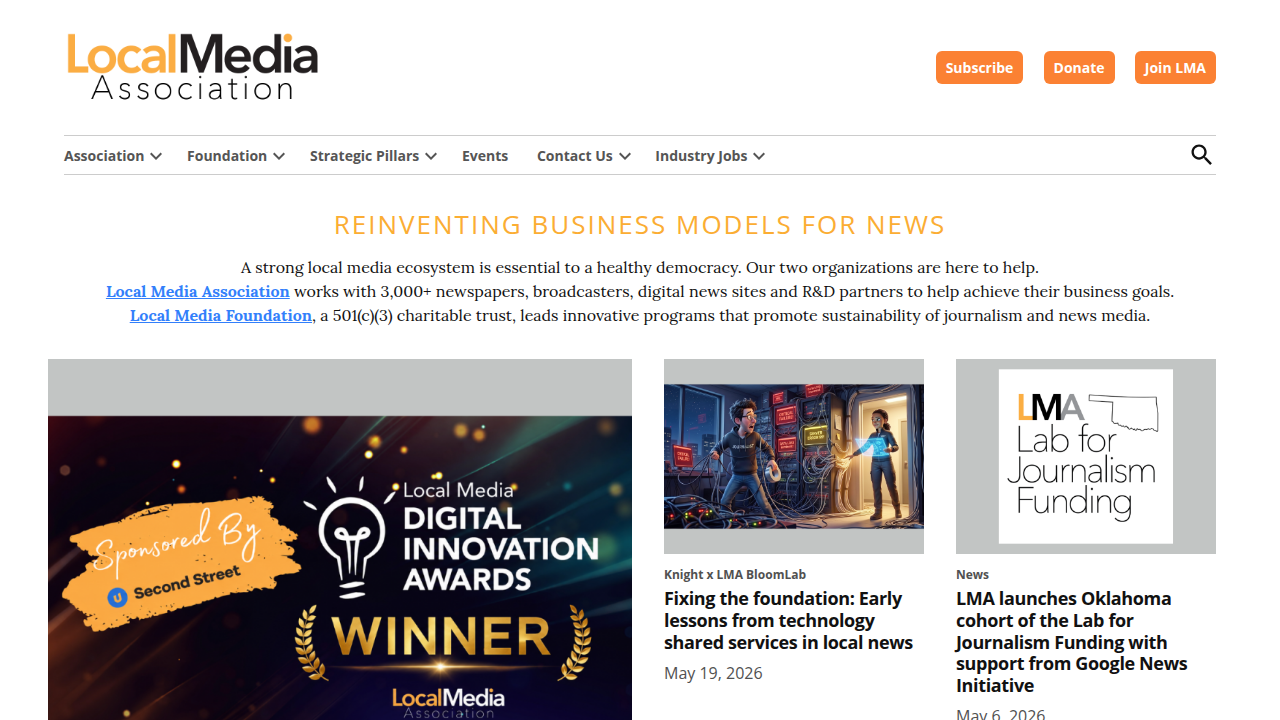
According to the Local Media Association, this is a year for local media to thrive by reinventing business models.
A company like Townsquare Media is perfectly placed to lead this charge. While Range Media Partners handles national celebrities and the Cardenas Marketing Network connects brands with event audiences, Townsquare builds deep roots in local communities. Agencies like Growthscribe Marketing Agency are helping these networks track exactly how well local engagement turns into real revenue.
What about regulation? New data privacy rules are changing the playing field. Here, local media has a huge advantage. Because they have direct, trusted relationships with their audience, they own valuable first-party data. This gives them a competitive edge over bigger, less personal platforms.
Innovation is also rushing in. AI tools are making it simpler to produce and distribute content. Immersive audio formats, like interactive podcasts, are creating fresh ad opportunities. The industry is actively discussing how to adapt. You can hear some of these smart ideas in the discussion on whether local news can keep up in 2026.
To stay ahead of these rapid shifts in local media, regulation, and tech, you need daily insights.
Get Free Updates from The Deep View Newsletter.
The Resurgence of Local Media
You might be wondering if local news is actually making a real comeback. The short answer is yes. In 2026, people are fed up with faceless algorithms. They want real, human connections. That is exactly what local media offers.
According to the Local Media Association, this year is all about reinventing business models for news. And that is where Townsquare Media shines. With over 400 local brands in mid-sized markets, Townsquare already has the trust and the reach that national networks like Range Media Partners just cannot match. Meanwhile, agencies like Growthscribe Marketing Agency are helping these local networks prove that community engagement translates into real dollars.
The conversation is not slowing down either. You can hear more about the challenges and opportunities in a recent discussion on whether local news can keep up in 2026.
If you want to stay ahead of these shifts and understand how to build audience trust in your own strategy, it pays to track the daily signals.
Get Free Updates from The Deep View Newsletter.
Regulatory and Privacy Impacts
Now, data privacy laws are shaking up how media networks make money. In 2026, state level U.S. laws and updates to GDPR make old school ad targeting much harder. If you rely on third party cookies, you are losing ground fast.
Networks that own strong first party data will win. That is where Townsquare Media has a big edge. They already collect direct audience data across their 400 local brands. This lets them serve targeted ads even when privacy rules tighten. Competitors like Range Media Partners and Growthscribe Marketing Agency are also building their own data strategies.
These shifts are part of a bigger reinvention in local media. The Local Media Association points out that 2026 is the year to explore new business models. Smart networks are already adapting.
You need to stay on top of these changes too.
Get Free Updates from The Deep View Newsletter for daily insights on media trends and audience strategies.
Summary
This article maps the 2026 media network landscape, showing how companies mix local reach with digital scale to win ad dollars. It uses Townsquare Media as a clear example of a