Types of Google Ads Nine Campaign Formats Media Professionals Need to Know
Introduction
If you have spent any time in media recently, you know the landscape is shifting fast. AI tools are changing how content gets made. New platforms pop up every quarter. And audience habits feel like they change overnight.
That is why understanding the types of google ads matters more than ever in 2026. Media professionals like you need to reach the right people without wasting budget. But Google offers so many campaign formats now it can feel confusing.
Actually, here is the thing. There are nine main Google Ads campaign types today: Search, Display, Video, Shopping, Discovery, App, Local Services, Performance Max, and Smart campaigns. That is according to Redback Solutions, which tracks these formats closely. Each one serves a different purpose. And picking the wrong one costs you time and money.
Display ads, for example, let you show visual banners across millions of websites. But they work best for brand awareness, not direct sales. On the other hand, Search ads catch people who are already looking for what you offer. The trick is matching the right format to your media goal.
A skilled ppc agency knows how to blend these online advertising platforms into a strategy that actually drives results. They test, measure, and optimize based on real data.
This guide will walk you through every major types of google ads format. You will learn what each one does best, when to use it, and how to avoid common mistakes.
And if you want to stay ahead of rapid changes in AI and media technology, consider joining a community that tracks these shifts daily. Subscribe Free to The Deep View Newsletter for clear daily updates you can actually use.
The Full Spectrum of Google Ads Campaign Types in 2026
So you know there are many formats. But which one actually fits your media goals? Let’s walk through each major campaign type so you can see the full picture.

According to Redback Solutions, Google currently offers nine campaign formats: Search, Display, Video, Shopping, Discovery, App, Local Services, Performance Max, and Smart campaigns. Each type serves a unique purpose in the media landscape. Here is how they break down for professionals like you.
Search campaigns show text ads when people type queries into Google. These work best when your audience already knows what they want. For media companies, that means catching users searching for breaking news, specific shows, or industry insights.
Display campaigns place visual banners across millions of websites and apps. If you want to build brand awareness for a new media property or a streaming series, this is your go to. The Improvado guide explains that display ads rely on images and targeting rather than search intent.
Video campaigns run ads on YouTube and other video partners. Media professionals use these to promote trailers, clips, or full episodes. They also work well for audience retargeting after someone watches part of your content.
Discovery campaigns appear across YouTube Home feed, Gmail promotions, and Google Discover. They let you reach users before they search, which is perfect for introducing a new podcast or newsletter.
Performance Max is Google’s AI powered campaign type. It blends Search, Display, Video, Shopping, and Discovery into one automated campaign. Google calls it their most advanced format, and it uses machine learning to find conversions across all channels. Starting June 15, 2026, the Google Ads API will begin transitioning product reporting to include data from all Performance Max networks, as noted on the Google Ads Developer Blog.
App campaigns promote mobile apps across Google’s network. If you run a media app for news, streaming, or content consumption, this format drives installs and engagements.
The big news from Google Marketing Live 2026 is that new AI innovations now help you create, capture, and convert demand more efficiently. These updates make it easier to automate your ad creation and targeting.
A smart media strategy uses multiple types. You might use Search for direct response, Display for awareness, and Performance Max for scale. The best approach depends on your specific goals.
Want to stay updated on how AI is reshaping these ad formats and the broader media industry? Get Free Updates from The Deep View Newsletter, which delivers clear daily insights on technology and AI that you can actually apply.
Matching Google Ads Types to Media Industry Goals
Okay, so you have a good handle on the different campaign formats. But which ones actually move the needle for a media company? Let’s break it down by your biggest goals.
Search Ads for subscriptions and content discovery. When someone Googles "latest streaming documentary" or "how to start a podcast," they have high intent. Search ads let you show up right there. Media companies use them to drive subscription sign-ups and send readers directly to specific articles or shows. This is where you capture people who already know what they want. According to 2026 benchmarks, Google Ads delivers the highest median ROAS of any major platform at 3.52x, making it a strong choice for direct response goals.
Display and Video Ads for brand awareness and ad revenue. If you want to introduce a new media brand or promote a series before people search for it, display ads are your friend. They run across millions of websites using visual banners. Video ads on YouTube let you show trailers, clips, or even full episodes. And here is the bonus: many media companies also run these ads on their own properties through programmatic advertising. That means you can earn ad revenue by letting other advertisers place display ads on your site, turning your audience into income.
Performance Max as your all-in-one solution. This is Google’s AI powered campaign type that blends Search, Display, Video, Shopping, and Discovery together. For media companies, Performance Max is great for driving conversions across all Google properties without manually managing separate campaigns. The AI finds the best placements based on your goals. Starting June 15, 2026, Google Ads API will include data from all Performance Max networks, giving you better insights.
A smart media strategy uses a mix. Use Search for direct sign-ups, Display and Video for building awareness, and Performance Max to scale efficiently across the whole system.
Want to stay updated on how AI is reshaping these ad formats and the broader media industry? Get Free Updates from The Deep View Newsletter, which delivers clear daily insights on technology and AI that you can actually apply.
PPC Agency Optimization Strategies for Media Campaigns
So you have picked your ad types. Now comes the hard part. How do you make sure every dollar works as hard as possible? Let’s look at what the best PPC agency teams focus on in 2026.
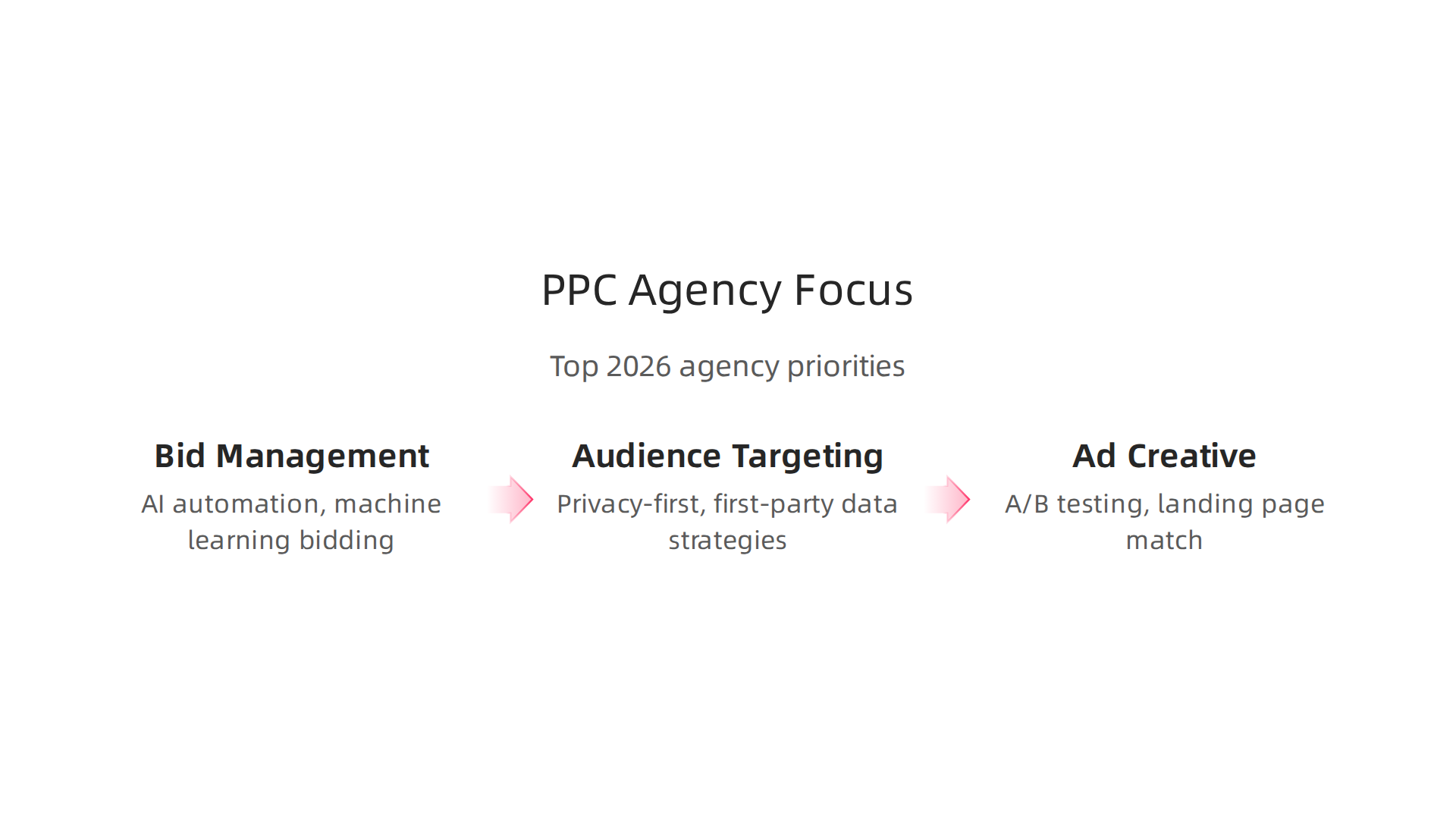

Bid management strategies that actually work
Bidding is not just about setting a number and hoping for the best. In 2026, pay-per-click advertising relies heavily on AI automation and machine learning bidding. Smart media campaigns use automated bidding strategies like Target CPA and Target ROAS. These let Google’s algorithms adjust bids in real time based on who is searching and how likely they are to convert.
But here is the trick. You cannot just turn on automation and walk away. You need seasonality adjustments. If you know a big streaming release is coming next month or a major news event is on the horizon, add those adjustments manually. This tells the system to bid more aggressively during your biggest moments.
Audience targeting with first-party data
Privacy changes have changed everything. Third-party cookies are fading fast. The winning play for media companies in 2026 is privacy-first targeting and first-party data strategies. You already have valuable information about your subscribers, newsletter readers, and content consumers. Use it.
Customer Match lets you upload your email lists directly to Google Ads. Then you can serve ads specifically to people who already know your brand. Even better, create lookalike audiences from those lists. Google finds new people who share the same behaviors as your best subscribers. This is one of the most powerful ways to grow your audience without wasting budget on cold traffic.
For media companies, this type of targeting is gold. You can promote a new documentary series directly to people who watched similar content before. Or sell a premium subscription to readers who visit your site daily but have not converted yet.
Ad copy and creative optimization
You can have the best targeting in the world. But if your ad copy is boring, nobody clicks. The solution is constant testing. Run A/B tests on your headlines, your call-to-action buttons, and even your landing pages.
Small changes make a big difference. Try switching "Subscribe Now" to "Start Your Free Trial" and see what happens. Test different value propositions. Does your audience care more about exclusive content or ad-free experiences? The data will tell you.
Make sure your landing page matches your ad promise. If your ad says "Watch the First Episode Free," the landing page better show that exact episode right away. Any disconnect kills your conversion rate.
The best PPC agencies combine these three areas. Smart bidding, first-party audiences, and relentless creative testing. Put them together and you get campaigns that actually move the needle for your media brand.
Want to stay ahead of how AI is changing these strategies? Subscribe Free to The Deep View Newsletter for clear daily insights on technology and AI that you can apply to your media campaigns.
Common Pitfalls in Media Google Ads Campaigns and How Agencies Avoid Them
Even with a solid strategy, things can go wrong fast. Many media companies make the same mistakes over and over. Let us look at three common pitfalls and how a good PPC agency avoids them.
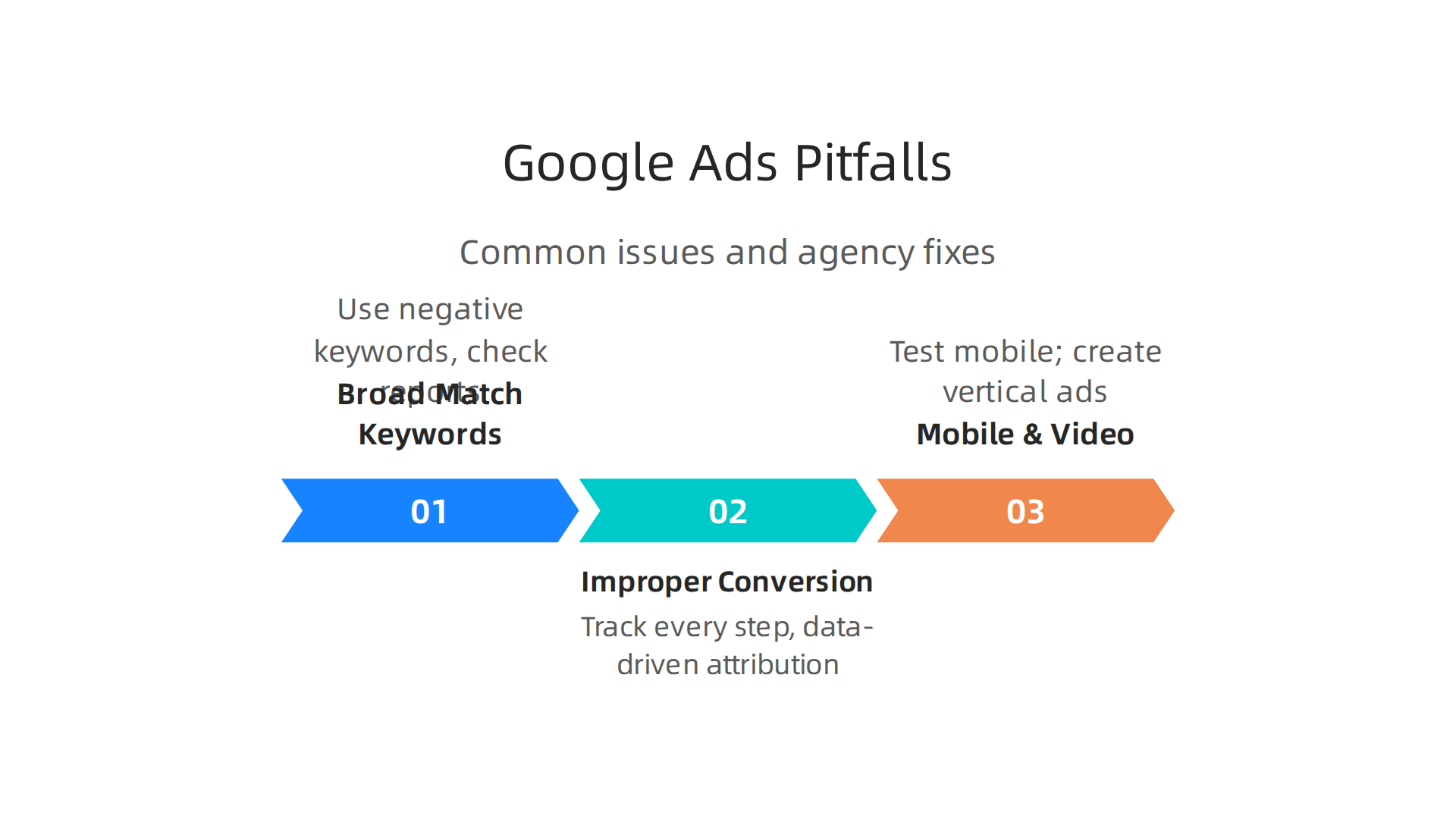
Pitfall 1: Over-relying on broad match keywords without negative keywords
This is a budget killer. Broad match keywords let Google find related searches. That sounds great. But without negative keywords, you pay for clicks from people who want something totally different.
For example, if you run ads for "news subscription" without negatives, you might show up for "free news" or "news archive." Both waste your money. According to Navoto’s guide on common Google Ads mistakes, this is one of the top errors in 2026.
How agencies fix it: They build a strong negative keyword list from day one. They also check search term reports weekly to find new irrelevant terms and add them to the list. This keeps your budget focused on real potential customers.
Pitfall 2: Improper conversion tracking across multi-step funnels
Media campaigns rarely convert in one click. A reader might read an article, sign up for a newsletter, and then subscribe weeks later. If you only track the last click, you miss the full picture.
One of the key PPC trends reshaping performance marketing in 2026 is the need for proper attribution across these complex funnels. Without it, you might cut campaigns that actually drive valuable newsletter signups because they do not show immediate subscriptions.
How agencies fix it: They set up conversion tracking for every step. Article reads, newsletter signups, free trial starts, and paid subscriptions all get tracked. Then they use data-driven attribution models to give credit where it is due. This reveals which content and ad types truly move people down the funnel.
Pitfall 3: Ignoring mobile and video optimization
Here is a hard truth. Most of your audience is on their phones. And they watch video. If your ads look bad on mobile or ignore video placements, you miss massive reach.
How agencies fix it: They test every ad on mobile devices before launch. They create vertical video ads designed for YouTube Shorts and other mobile-first placements. And they check their landing pages load fast on phones. Small changes here make a big difference in your click-through rates.
Avoiding these pitfalls takes constant attention. The landscape changes fast. Get Free Updates from The Deep View Newsletter to stay on top of the latest trends in media advertising and AI.
Measuring Success: KPIs and Attribution Models for Media Companies
You run ads across different types of Google Ads. Maybe you use search ads for people looking for news. You use display ads to build brand awareness. And you run video ads on YouTube to tell your story. But here is the real question. How do you know which ad actually led to a subscription?

A lot of media companies look only at ROAS. That is return on ad spend. It tells you how much money you made for every dollar spent. And yes, ROAS matters. In 2026, Google Ads delivers a median ROAS of 3.52x across all industries, according to rule1.ai. But for media companies, that number can be misleading. Why? Because your subscribers do not convert in one click.
That is why smart media teams track KPIs that matter more for their business model.
KPIs that go beyond ROAS
For media companies, the real measurement starts with three numbers.
Cost per subscriber. How much do you pay to get one new paid subscriber? This number tells you if your campaigns are sustainable. If your cost per subscriber is higher than the average lifetime value, you are losing money.
Cost per engaged visit. Not all visits are equal. An engaged visit is someone who reads an article, watches a video, or spends real time on your site. This KPI helps you understand which ads bring quality traffic, not just clicks. The average Google Ads conversion rate across all industries is about 6.96%, according to Wordstream. But media sites often see lower conversion rates because their funnel is longer.
Lifetime value (LTV). This is the total money a subscriber brings over their entire relationship with your brand. If your LTV is high, you can afford higher costs per subscriber. If it is low, you need to tighten your bids.
The attribution challenge for media companies
Here is the thing. A reader might first see one of your display ads on a news site. They click but do not subscribe. Two weeks later, they search for your brand on Google and click a search ad. They sign up for your newsletter. A week after that, they see a YouTube ad and finally subscribe.
Which ad gets the credit? If you use last-click attribution, the YouTube ad gets all the credit. But the display ad and search ad played huge roles. You might cut those campaigns because they do not show direct conversions. That is a mistake.
Attribution models solve this problem. They spread credit across all the touchpoints. According to Stape’s guide on marketing attribution models, choosing the right model in 2026 is critical for optimizing cross-channel campaigns. For media companies, a data-driven or time-decay model often works best. These models give more credit to touchpoints that happen closer to the conversion, but they still recognize earlier interactions.
Using Google Analytics 4 and Google Ads together
You do not need expensive software to start. Google Analytics 4 and Google Ads work together to give you a clear picture. GA4 lets you see the full user journey across devices. You can connect it to your Google Ads account to see which campaigns drive engaged visits, newsletter signups, and subscriptions.
Set up conversion events for every step of the funnel. Read an article. Sign up for a newsletter. Start a free trial. Become a paid subscriber. Then use GA4’s attribution models to assign credit. You can compare different models to see how your budget should shift.
Agencies that specialize in media campaigns already do this. They use cross-channel attribution to stop wasting money on ads that look good but do not build your subscriber base over time. The right measurement system turns your ads into a real growth engine.
Want to stay ahead of these trends? Subscribe Free to The Deep View Newsletter for daily AI and media insights.
Future Trends in Google Ads for Media (2026 and Beyond)
You have built a solid measurement system. You know your KPIs. You understand attribution. But the tools you use today might not work as well next year. Google Ads is changing fast.

And media companies need to pay attention to three big trends that will shape how you buy and measure ads in 2026 and beyond.
AI is running the show
Artificial intelligence now powers most campaign creation and optimization inside Google Ads. Performance Max campaigns use AI to decide where to place your ads across Search, Display, YouTube, and Discovery. Google is also rolling out deeper Gemini integration to help you generate ad copy, images, and even video assets.
In 2026, pay-per-click (PPC) advertising relies heavily on AI automation, predictive analytics, and machine learning bidding, according to Thrive Internet Marketing Agency. That means less manual tweaking and more trust in the algorithms. For media companies, this is good news. AI can find the right audience faster than any human can. But you still need to watch your cost per subscriber and make sure the AI is not wasting budget on low-quality traffic.
Privacy is the new priority
Here is the thing. Third-party cookies are disappearing. Google has been phasing them out, and by 2026 the shift is real. You can no longer rely on tracking people across the web. Instead, you need first-party data. That means email signups, subscriber lists, and direct relationships with your audience.
The primary PPC trends for 2026 center on AI-driven automation, privacy-first targeting, and first-party data strategies, notes Improvado. Media companies that build strong email and newsletter audiences will have a huge advantage. You can upload your subscriber lists to Google Ads and create custom audiences. This lets you run display ads or YouTube ads to people who already know your brand. It is more effective and respects privacy.
Video and interactive ads are taking over
People do not just read anymore. They watch. They interact. Google Ads now supports more video formats and interactive ad types. YouTube Shorts ads, bumper ads, and in-stream ads are getting more attention. But the bigger shift is toward shoppable and interactive ad formats that let users engage without leaving the ad.
Studies show that audiences spend more time with video content than static images. For media companies, this is a chance to tell your story in a richer way. Use video ads to preview an article or documentary. Use interactive ads to let users choose the content they want to see. According to HubSpot’s 2026 marketing statistics, video remains one of the most effective formats for engagement and conversion.
The old ways of running Google Ads are fading. AI is handling the heavy lifting. Privacy is forcing you to own your audience data. And video is becoming the default format. If you want to stay competitive, start testing these trends now.
Need daily guidance on how AI is reshaping media? Subscribe Free to The Deep View Newsletter for simple, clear updates every morning.
How to Choose the Right PPC Agency for Your Media Business
You have learned where Google Ads is heading. AI is doing more of the work. Privacy rules are changing. Video is taking over. But even with all those trends, most media companies still need a partner to run their campaigns well. The question is: how do you pick the right PPC agency?
Start with three criteria that matter most for media businesses.
Vertical specialization matters. Look for an agency that already works with publishers, streaming services, or content creators. They should understand metrics like cost per subscriber, churn rate, and lifetime value. A general PPC agency might waste your budget on clicks that never convert to loyal readers. An agency that knows your space will pick the right types of Google Ads for your goals, whether that is display ads to build awareness or video ads to drive engagement.
Transparency in reporting is non-negotiable. The agency should show you clear reports every month, not just a dashboard full of flashy numbers. They should explain what worked, what did not, and why. Watch out for agencies that only report on vanity metrics like impressions or click-through rates without connecting them to your actual business outcomes. According to a guide on choosing a PPC agency from Clutch.co, you want a partner who shares honest, meaningful data that helps you make decisions.
Experience with media KPIs is a must. Your success is not measured by sales of a product. It is measured by subscriber growth, ad revenue, and audience engagement. The agency should be comfortable optimizing for those specific targets.
Now, watch for red flags. A good agency will not promise guaranteed results. No one can control the auction or user behavior. They will also have real case studies you can review. If they avoid sharing examples, walk away. And stay far away from any agency that uses black-hat tactics like click fraud or sneaky redirects. Those can get your Google Ads account banned. Both Embertribe and ClicksGeek warn that vague promises and refusal to share specifics are major warning signs.
Here is a simple vetting process. First, audit their existing client results. Ask for five client references and call them. Second, request a trial campaign proposal. See how the agency thinks about your audience and your budget. Third, check references thoroughly. If past clients are happy, you have a good sign.
Choosing the right partner can save you months of wasted ad spend. Take your time. Ask the hard questions. Your budget and your subscribers depend on it.
Want to stay ahead of the latest PPC trends in media? Subscribe Free to The Deep View Newsletter for simple, daily AI insights that help you make smarter advertising decisions.
Summary
This article explains the nine main Google Ads campaign types in 2026 and shows media professionals how to match each format to concrete business goals like subscriptions, engagement, and ad revenue. It describes what Search, Display, Video, Shopping, Discovery, App, Local Services, Performance Max, and Smart campaigns do, and why Performance Max and AI-driven automation are increasingly important. You’ll learn practical optimization strategies—smart bidding, first‑party audience targeting, and creative testing—plus common pitfalls to avoid such as poor keyword controls, weak conversion tracking, and neglecting mobile/video. The guide also covers measurement best practices for media, including KPIs (cost per subscriber, cost per engaged visit, LTV), attribution models, and using GA4 with Google Ads. Finally, it outlines future trends—AI, privacy-first targeting, and interactive video—and gives criteria for vetting PPC agencies that specialize in media. After reading, you’ll know which campaign types to use, how to set up tracking and audiences, and how to evaluate or select an agency to scale your media business efficiently.