How to Write a Social Media Policy 2026 That Protects Your Brand
Introduction: Why Your Social Media Policy Needs a 2026 Refresh
Social media moves fast. In 2026, over 5.79 billion people use social platforms worldwide. That is roughly 70 percent of the global population, according to Social Network Usage & Growth Statistics (2026). Every one of those users could be talking about your brand, sharing your content, or posting something that puts your organization at risk.
But here is the problem. Most companies still rely on social media policies written three, five, or even ten years ago.

Those old templates were built for a different world. They do not cover AI-generated content. They have no rules for deepfakes. They ignore how employees now act as brand creators on their personal accounts. And they certainly do not address the new platform rules that change almost monthly.
That gap is dangerous. Without a clear policy, one employee post or one AI-generated image could cause a legal headache or a public relations mess. The stakes are higher than ever as regulators pay closer attention to what companies post and how they use automated tools. For a deeper look at how the industry is adapting, check out our coverage of Adweek Social Media Week 2026 key takeaways.
This article gives you a practical blueprint. You will find real social media policy examples, clear legal context, and strategies that actually work for 2026 and beyond. No fluff. No generic templates. Just actionable steps to build a policy that protects your brand while letting your team thrive online. And because AI is rewriting the rules every week, staying informed matters. That is why we recommend The AI Newsletter Worth Reading for daily updates on the technology reshaping your social media strategy.
Why Social Media Policies Matter More Than Ever in 2026
The stakes are higher than ever.
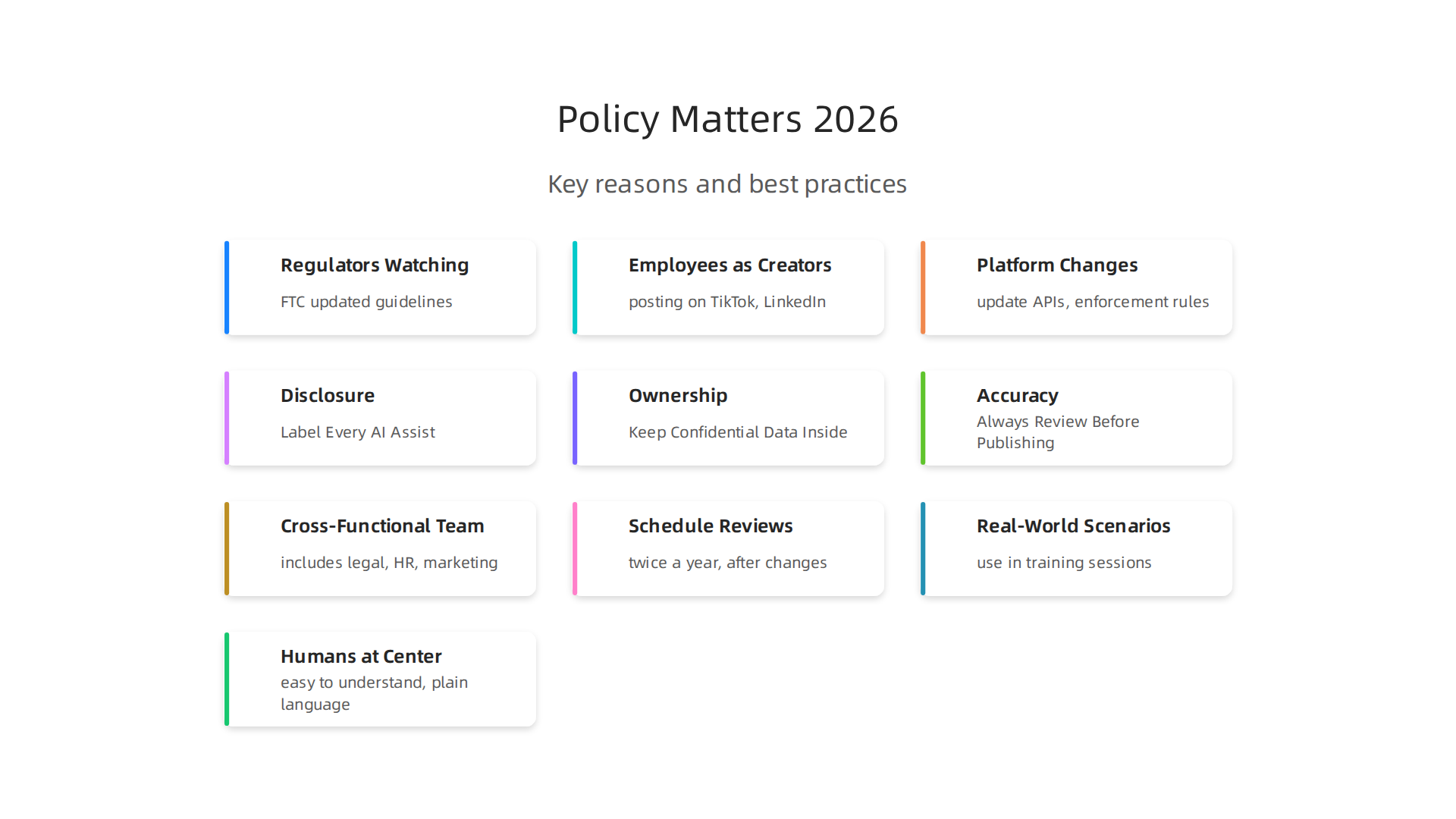
In 2026, regulators are watching closely. The Federal Trade Commission has updated its guidelines. State lawmakers have passed new laws. These changes touch data privacy, AI disclosure, and how companies must label sponsored content.
Consider this. Several states now require clear disclosure when brands use AI to create or modify content. Your social media policy must tell employees exactly when and how to label AI-generated posts. Without that rule in place, your company could face fines or legal trouble. For an overview of this evolving landscape, check the latest on Social Media and Children 2026 Legislation.
But regulation is only part of the picture. Your employees are also content creators now. Every day, your team posts on TikTok, LinkedIn, and Instagram. Some share their professional opinions. Others post brand-related content on personal accounts. Without clear guardrails, a single offhand remark can spiral into a PR crisis. A 2026 trend report from National University highlights that consumers crave authenticity online and often turn to user-generated content. That is great for marketing but risky without a policy that defines what employees can and cannot say about your brand.
Then there are platform changes. Social networks update their APIs and enforcement rules constantly. A post that was fine last year might violate a new community guideline today. Your policy needs to keep up. It should give your team clear rules for responding to platform updates, removing old content that no longer complies, and managing brand accounts when API access changes.
A strong policy turns these risks into strengths. It protects your brand, builds trust with your audience, and gives your team confidence to post. And when you pair clear guidelines with the right tools, everything runs smoother. That is why we recommend exploring best social media management tools to help enforce your policy at scale.
Without a modern social media policy, you are gambling with your reputation. With one, you take control.
Core Components of an Effective Social Media Policy
A strong policy starts with clear scope.

It must name exactly who it covers. That includes full-time employees, part-time contractors, executives, and brand ambassadors. Everyone who represents your company online needs to know the rules. Your policy should also list every platform in scope. Do not just say "social media." Name TikTok, LinkedIn, Instagram, X, and any emerging platforms your team uses. The SHRM guide on how to create an effective social media policy recommends identifying two clear roles: official spokespeople and unofficial voices. Only the first group can speak for the company.
Next, draw a clear line between professional and personal accounts. Your employees can express themselves on their own time. But they must not share confidential information or attack the brand. Platform-specific behavior also matters. Posting on LinkedIn requires a different tone than posting on TikTok. Set those expectations now.
Here is a must-have in 2026. Your policy must include an AI disclosure clause. When employees use AI tools to write or edit posts, they need to label that content. Several states now require it by law. This protects your company from fines and builds trust with your audience.
For a ready-to-use starting point, review the Social Media Policy Template from SHRM. It covers all the basics and can be customized to your team.
And as AI reshapes how content gets created, staying informed matters. That is why we recommend The AI Newsletter Worth Reading. It delivers clear daily AI updates so your policies stay current.
Scope and Applicability
Your social media policy must clearly define which accounts are covered. This includes personal accounts, professional accounts, and brand-owned accounts. Personal accounts used for work purposes need rules too. So do personal accounts where employees sometimes mention the company. The law in many places protects workers when they discuss pay, hours, or working conditions online. Employers cannot punish people for that kind of talk. The article on employee social media rights in 2026 explains these protections. But posts that share confidential info or harass others can still lead to discipline.
Geographic rules matter a lot. A policy that works in New York may break laws in the European Union. The EU has strict data privacy rules through GDPR. California has its own labor laws too. You need to adjust your policy for each region where you have employees. The SHRM page on employment law and compliance can help track updates.
Finally, do not forget third-party partners and freelancers. They represent your brand too. Your policy should apply to them and spell out the consequences if they break the rules. If you work with agencies, you might want to read about how to vet a media agency to set clear expectations upfront.
Content Guidelines and Brand Voice
Your social media policy must define brand voice while giving creative teams room to work. Editorial staff especially need this balance. They must sound authentic without risking brand safety.
AI-generated content needs its own rules in 2026. Your policy should require clear labels on any post created or heavily edited with AI. Platforms like Meta, YouTube, and TikTok already enforce this. The AI disclosure requirements guide for businesses covers what each platform expects and how new state laws add more rules. Your policy should also define who approves AI content before it posts and who takes responsibility for errors.
Some content should be banned without exception. Hate speech, harassment, and misinformation have no place on your brand channels. Neither do posts sharing confidential data or trade secrets. State these rules clearly so no one can claim confusion.
To help teams apply these guidelines smoothly, use the best social media management tools in 2026 to automate compliance checks and approval workflows. For daily updates on changing AI rules, subscribe to The AI Newsletter Worth Reading and stay ahead of new regulations.
Consequences and Enforcement
Even with clear guidelines and good tools, people will still make mistakes. That is why your policy needs a clear enforcement system. The best approach is progressive discipline. This means consequences start small and get more serious if problems keep happening.
Most companies follow a simple ladder. First, a private verbal warning. The manager explains the issue and documents the conversation. If the behavior continues, the next step is a formal written warning. That written warning includes details on what rule was broken and what the employee must do to fix it. After that, a suspension may happen. For severe violations like sharing confidential data or hate speech, you can skip straight to termination. The progressive discipline steps from AIHR explain exactly how to apply these stages fairly.
Documentation matters at every step. You need records of the date, time, what was said, and who was present. Store these notes safely. They protect your company if someone challenges the decision later.
Regular training refreshers keep everyone on the same page. Your team should review the policy at least once a year. This is especially important as social media marketing platforms and AI tools change fast. Use the training to walk through real examples from social media marketing news so employees see what good and bad look like in practice. When everyone knows the rules and the consequences, enforcement becomes much easier.
Social Media Policy Examples by Industry
A one-size-fits-all policy rarely works.

The risks a media company faces are very different from those in healthcare. The rules for tech companies look different too. That is why you need social media policy examples tailored to your industry. Let us walk through three major sectors.
Media and Publishing: Balancing Editorial Independence with Brand Guidelines
Media and publishing companies walk a tightrope. Reporters and editors need the freedom to share news quickly. But every post also reflects the company brand. Your policy should protect editorial independence while setting clear brand safety rules.
In 2026, AI disclosure has become a top concern for publishers. The Interactive Advertising Bureau (IAB) released the industry’s first AI Transparency and Disclosure Framework to help brands label AI-generated content in ads. Media companies should require employees to label synthetic images, videos, or audio clearly. Platform rules matter too. YouTube, Meta, and TikTok each have their own disclosure requirements for AI content.
A strong policy includes rules for verifying sources before sharing, never posting internal editorial notes, and always using the company’s approved brand voice. Using the right best social media management tools can help automate approvals and track disclosures so nothing slips through.
Tech Companies: Heavy Emphasis on AI and Data Security
Tech companies live and breathe innovation. But that also means higher risks around AI misuse and data leaks. Your social media policy must put AI guardrails front and center. In 2026, the FTC requires double disclosure for AI-involved sponsored content. You must state both the paid relationship and the fact that AI helped create the content.
Employees should disclose whenever they use AI to write, edit, or generate images for company accounts. They should never share unreleased product specs, internal code, or confidential customer data. Many tech firms limit social media posting to a small team of approved brand managers. Regular training on the latest AI disclosure rules for brands and influencers keeps everyone in the know.
Healthcare and Finance: Strict Compliance with HIPAA and FINRA
Healthcare and finance operate under some of the tightest regulations in business. HIPAA protects patient privacy. FINRA oversees financial advisors. A single social media slip can lead to huge fines or even lost licenses.
Your policy should require pre-approval for every post. A compliance team must review content before it goes live. Never share patient testimonials, images, or case details without explicit written consent. Financial advisors cannot promise specific returns or give individual investment advice in comments. Automated monitoring tools and clear audit trails are essential. The social media compliance guide for regulated industries lays out practical steps to follow.
Each industry has its own risks, but clear written policies make compliance much easier. Review your rules every year and update them as platforms and laws change.
To stay ahead of fast-moving AI regulations and platform changes, subscribe to The AI Newsletter Worth Reading. It delivers clear daily updates straight to your inbox.
The AI Factor: Updating Policies for a Generative World
Generative AI changes everything about social media. Today, anyone on your team can use ChatGPT to draft a post, DALL·E to create an image, or ElevenLabs to clone a voice. That speed is powerful. But without the right rules, it also creates real brand risk.
Your policy in 2026 needs new clauses that cover three big areas: disclosure, ownership, and accuracy.
Let us break each one down.
Disclosure: Label Every AI Assist
The days of quietly using AI are over. Regulators around the world now require clear labeling. The EU AI Act, for example, demands transparency for any synthetic content. A guide to updating social media policies for the age of AI explains that employees should stay responsible for content whether AI helped or not. That means you need a rule: if AI touched it, label it.
In practice, that includes marking AI-generated images with visible watermarks or captions. Some platforms already require this. Meta asks for labels on political ads that use AI. TikTok bans fully synthetic content that shows real people without consent. Your policy should name these platform rules and say who owns the task of applying labels.
Ownership: Keep Confidential Data Inside
Another big risk is leaking private information. Employees might paste client data, internal strategy notes, or source code into a public AI tool. Those prompts often get stored on external servers. Your policy must forbid entering confidential or proprietary information into unauthorized AI tools.
It should also address copyright. If an AI generates a post based on your brand’s style guide, who owns that output? Your company does. But if an employee uses a free AI tool that trains on your prompts, that ownership gets messy. Spell out that all AI-generated brand content belongs to the company, not the employee or the tool provider.
Accuracy: Always Review Before Publishing
AI is great at sounding confident and terrible at being correct. It can hallucinate facts, dates, and names. It might create an image that accidentally includes a competitor’s logo. That is why your policy must require human review before any AI content goes live.
The same goes for moderation tools. Many platforms now use AI to flag inappropriate comments or block spam. But these tools miss nuance. They might block a harmless joke or miss a subtle hate speech attack. Your policy should say that a human must review all flagged content before taking enforcement action.
Deepfakes and synthetic media add another layer of risk. Someone could create a fake video of your CEO making false promises. Your policy needs a crisis protocol: who verifies the real content, how to report impersonation to platforms, and when to issue a public statement.
A final piece of advice: update training regularly. AI tools change fast. Your navigating new media platforms strategy should include quarterly reviews of your AI policy to catch new tools and risks. Keep it practical. Keep it clear. And keep humans in the loop.
Best Practices for Implementing and Updating Your Policy
You have your AI rules written down. Now comes the harder part: making them stick. A policy only works if your team actually follows it and if it stays current as platforms and tools change. Here are the best practices that help you do both.
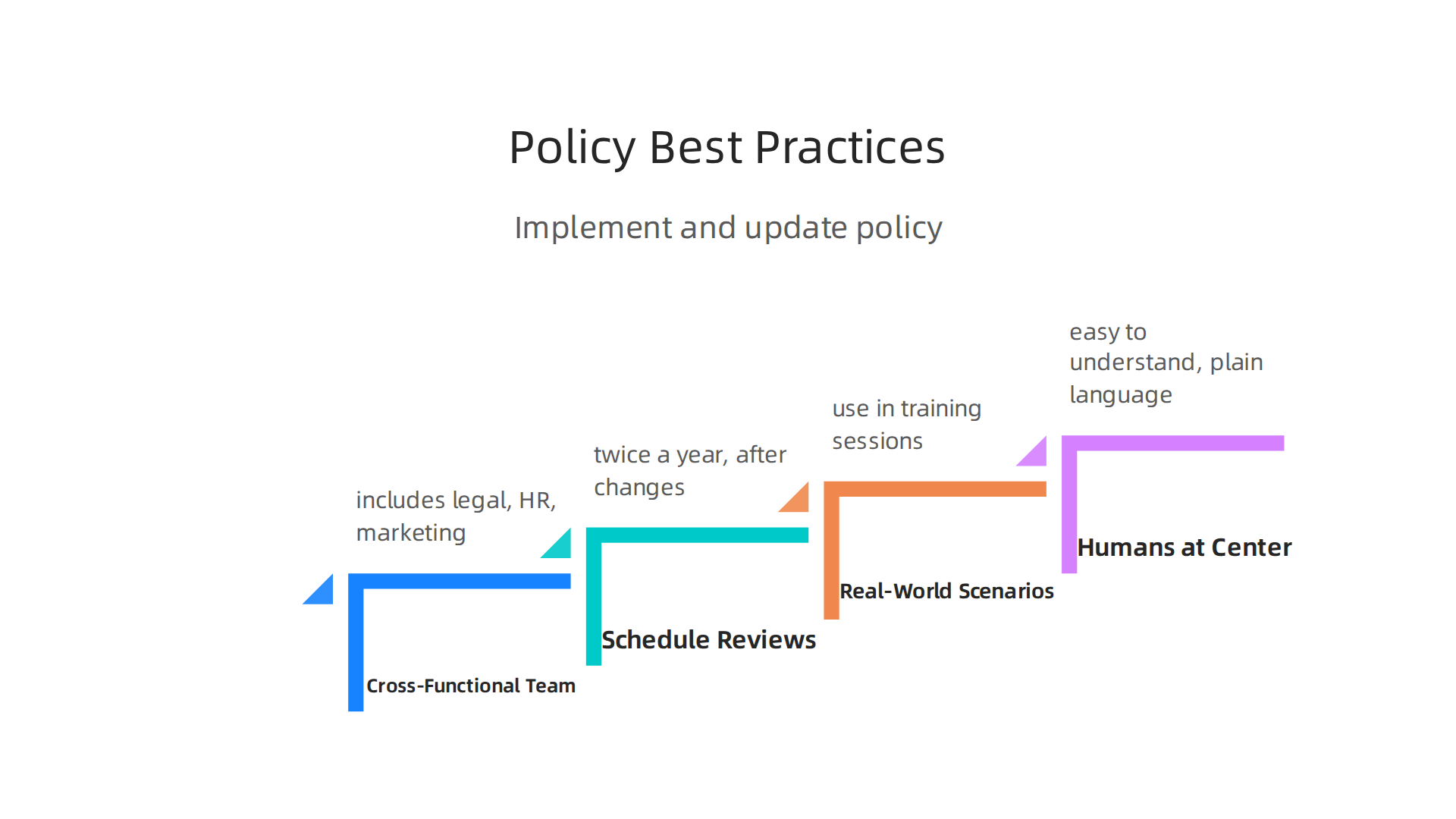
Build a Cross-Functional Policy Team
Don’t let one person write the policy alone. That is a recipe for blind spots. Instead, create a team that includes legal, HR, marketing, and editorial leads. Legal knows the regulatory risks. HR understands training and enforcement. Marketing sees how the policy affects creative workflows. Editorial knows the daily publishing reality.
When these four groups meet, they catch gaps. Legal might spot a disclosure rule that marketing missed. Editorial can flag a rule that would slow down breaking news coverage. HR can suggest a training schedule that works for every new hire. Together, they build a policy that is both protective and practical.
Schedule Reviews Twice a Year (and After Every Platform Change)
The social media world moves fast. A policy you wrote in January could be outdated by March. That is why you need a review cadence that is baked into your calendar.
Plan formal reviews twice per year. During these reviews, check every clause. Is your disclosure rule still matching platform requirements? Are your ownership clauses current with new AI tools? Has any platform updated its terms of service?
Also review your policy immediately after any major platform policy change. When Meta announced mandatory AI labels on political ads, teams that waited six months to update got caught. The teams that reviewed within a week stayed compliant. Treat these updates as urgent.
Use Real-World Scenarios in Training
Reading a policy document is boring. Most people skim it and forget the rules by lunch. To make the rules stick, use hands-on training that mirrors what your team actually faces.
Create three or four realistic scenarios. For example: "A junior editor uses ChatGPT to rewrite a headline but does not label it. What happens?" Or: "An intern pastes a client’s confidential brief into a free AI image generator. How do you respond?"
Have teams work through these scenarios together. Discuss the correct actions and the consequences of mistakes. This kind of interactive learning improves retention far more than a slideshow. One approach uses workshops with scenario-based simulations to prepare managers for real situations, and the same idea works for social media policy training. Let people practice so they learn before a real mistake costs you.
Another powerful tactic: run a "policy drill." Surprise your team with a fake violation, like a post that breaks your disclosure rule. See how quickly someone notices and escalates it. Then debrief together. This turns policy from a dusty document into a living practice.
Keep Humans at the Center
No matter how good your rules get, remember that people follow them. Make your policy easy to understand. Write it in plain language. Use examples. Keep a one-page cheat sheet that everyone can reference.
And when someone makes a mistake, treat it as a learning moment first. A supportive culture where people feel safe flagging their own errors will prevent bigger problems. That is how you build a team that actually owns the policy rather than just tolerating it.
To stay sharp on the fast-changing tech landscape that drives these updates, consider subscribing to The AI Newsletter Worth Reading for daily insights that help you adjust your policies as new tools arrive.
Even with a solid policy in place, most teams fall into one of three common traps. Here is how to spot and fix them before they cause real damage.
Pitfall 1: Making Rules So Strict That Nobody Wants to Share
Some companies write a policy that bans almost everything. No personal posts about work. No sharing company news unless legal approves it first. No tagging the brand without permission.
The result? Employees stop being brand advocates. They turn off notifications and treat your policy like a list of punishments. That kills the organic reach that makes social media powerful in the first place.
The fix is balance. Set clear boundaries around confidentiality and tone, but leave room for authentic sharing. A well-designed policy should be practical and aligned with how your company actually operates. That is one of the key lessons in this practical guide to social media policies. Let people feel proud to talk about their work. Just give them the guardrails they need.
Pitfall 2: Treating Brand Accounts and Personal Profiles the Same Way
A lot of policies lump everything together. They say "all employees must follow these rules on every platform at all times." That sounds simple, but it creates problems.
An employee sharing a funny tweet from their couch is not the same as an official brand posting a campaign video. When you blur those lines, you either restrict personal expression too much or leave official accounts without enough guidance.
Your policy needs a clear split. Define who is covered and when the policy applies. Many companies extend coverage to personal accounts when used in a business or professional context. That makes sense. But be explicit about it. This distinction is one of the six elements of a good social media policy that every organization should address. Your team will thank you for the clarity.
Pitfall 3: Forgetting That New Platforms Arrive Every Year
Think about your current policy. Does it mention Threads? Bluesky? Mastodon? If your document was written in 2023 and never updated, it probably lists only Facebook, X (formerly Twitter), and LinkedIn.
That is a problem. New platforms attract audiences fast. If a junior marketer starts posting on Bluesky without knowing the rules, you are exposed. Worse, if your policy is silent on those platforms, employees might assume the rules do not apply there.
The solution is to write your policy so it covers any platform where your brand or employees might appear. You can list examples but include a catch-all statement. Also, do not rely on one platform too heavily for your whole strategy. Distributing your presence across multiple channels protects you if one platform changes its algorithm or rules. That is a crucial lesson from this look at 5 social media mistakes to avoid in 2026.
Once you fix these three pitfalls, your policy will actually work for your team instead of against them. And if you want to explore the best tools to manage your social presence across all these platforms, check out this guide to best social media management tools in 2026.
Your policy might be solid today, but the social media landscape is shifting fast. Here is what is coming in 2027 and beyond that will demand updates to your approach.
Decentralized Platforms and the Metaverse Need New Rules
New kinds of social spaces are growing fast. Think decentralized platforms like Mastodon and Bluesky, plus immersive worlds in the metaverse. These spaces work differently than Facebook or Instagram. On decentralized platforms, no single company controls the rules. In the metaverse, users interact as avatars in virtual environments. That raises questions your current policy almost certainly does not answer.
How do you handle brand behavior in a virtual store? What about employee conduct in a metaverse meeting? Your policy needs to cover these scenarios now. A good starting point is to study the key trends in social media for 2027 that include immersive video and spatial web content. You will also want to look at how experimental marketing tactics translate into these new spaces. That is exactly what this breakdown of experiential marketing in 2026 covers — it shows how brands are already moving beyond flat screens.
Unified AI Disclosure Standards Are Coming
Right now, different platforms have different rules about AI-generated content. That is confusing for teams. But that is changing fast. Expect regulators and major platforms to converge on one standard requiring clear labeling of AI content. If your policy does not already say when and how to disclose AI use, it will need to by 2027.
This matters because consumers care deeply. Studies show that the top concern people have about brands on social is companies posting AI content without telling them. Your policy should set a single rule: always disclose AI assistance in a clear, noticeable way. No exceptions.
Employee Rights Will Demand More Transparency
Workers are pushing back against vague or secretive enforcement of social media policies. They want to know exactly what is banned, how violations are investigated, and what the consequences are. Future policies will need to be more transparent and include employee input. As you search for social media policy examples to guide your updates, look for ones that spell out enforcement steps clearly.
Staying ahead of these changes means keeping a close eye on social media marketing news and evolving best practices. Your social media management tools and your legal team should both be looped in. For a daily dose of clear insight on how AI and new platforms are transforming media policy, get The AI Newsletter Worth Reading from The Deep View. It will help you stay informed without the noise.
Summary
This article explains why every organization must refresh its social media policy for 2026, with a focus on AI, new regulations, and fast-changing platform rules. It walks through the essential policy components—scope, platform coverage, content guidelines, AI disclosure, ownership, and accuracy—and shows how to balance brand safety with employee authenticity. The piece outlines enforcement best practices (progressive discipline, documentation, regular training) and gives industry-specific examples for media, tech, healthcare, and finance. Practical implementation advice includes building a cross-functional policy team, scheduling twice-yearly reviews, using real-world scenario training, and keeping humans in the loop. It also highlights common traps to avoid and previews near-term trends like decentralized platforms and unified AI disclosure standards. After reading, you’ll have a clear blueprint to update or create a defensible social media policy that protects your brand and lets teams post with confidence.